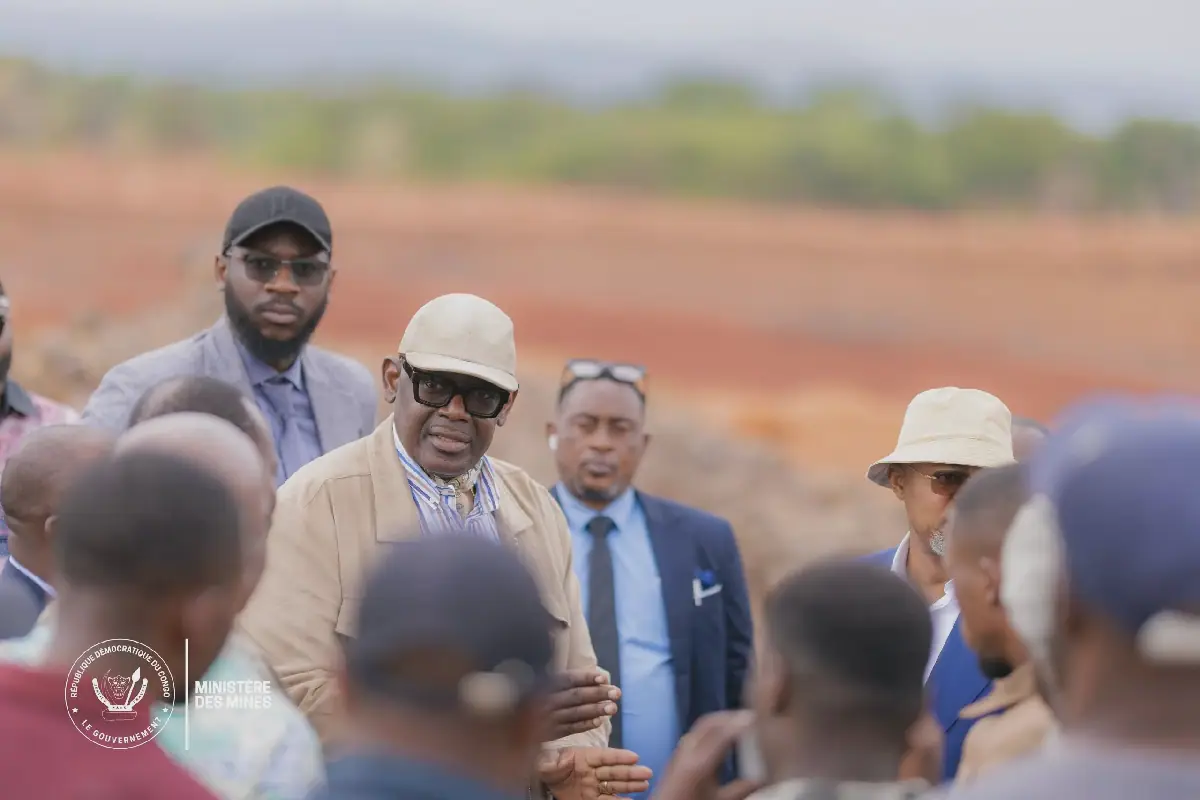
The Democratic Republic of Congo's Mines Minister, Louis Watum Kabamba, has overseen the resumption of artisanal mining activities in Mulondo, in the Lualaba province. On November 2, 2026, he supervised the reinstallation of members of the COMIKAN mining cooperative on two mining squares provided by the industrial operator PAJECLEM. This development brings an end to a long-standing social crisis that began with the eviction of artisanal miners and escalated into a deadly collapse and an aerial accident.
The crisis in Mulondo started with the transition of the mining site from CHEMAF to PAJECLEM, leading to the eviction of artisanal miners. The situation worsened on November 15, 2025, when a collapse occurred, resulting in multiple fatalities. This tragedy highlighted concerns over safety, regulation of artisanal mining, and coexistence between industrial operators and local mining communities. Minister Watum Kabamba had visited the site shortly after, narrowly escaping an aerial accident on November 17, 2025.
The resolution of the crisis involved extensive negotiations between stakeholders, including the ministry of mines, the Cadastre minier (CAMI), and the Service d’assistance et d’encadrement de l’exploitation minière artisanale et à petite échelle (SAEMAPE). The agreement allows for the coexistence of industrial and artisanal mining, with PAJECLEM ceding two mining squares for artisanal use. This arrangement aims to mitigate conflicts and promote structured coexistence between the two types of mining operations.
The agreement affects over 25,000 artisanal miners and has significant social implications for their families, who have been without a primary source of income for months. The resumption of artisanal mining is expected to revive part of the local economy, which is heavily dependent on mining activities. Minister Watum Kabamba emphasized the importance of adhering to the agreed terms and ensuring disciplined exploitation.
The successful implementation of this agreement depends on the respect of defined boundaries and the ability of parties to maintain a climate of trust. The minister's approach aligns with the vision of President Félix-Antoine Tshisekedi Tshilombo to ensure governance in the mining sector that balances regulation, security, and social realities. The situation in Mulondo will be closely monitored to assess the effectiveness of this arrangement.
The crisis and its resolution underscore the challenges of managing mining activities in the DR Congo, particularly in balancing the interests of industrial operators and artisanal miners. The agreement in Mulondo may serve as a model for addressing similar issues in other mining areas, ensuring that mining activities contribute to local economic development while minimizing social and environmental risks.
The reinstallation of artisanal miners in Mulondo marks a critical step towards resolving a complex social and economic crisis. With the support of the ministry of mines and other stakeholders, the affected communities can now look forward to resuming their activities and rebuilding their lives. The focus will be on sustaining this progress and ensuring that the mining sector contributes positively to the country's development.
Key points
- The agreement allows for the coexistence of industrial and artisanal mining in Mulondo.
- Over 25,000 artisanal miners are affected by the agreement.
- The resolution of the crisis involved extensive negotiations between stakeholders.