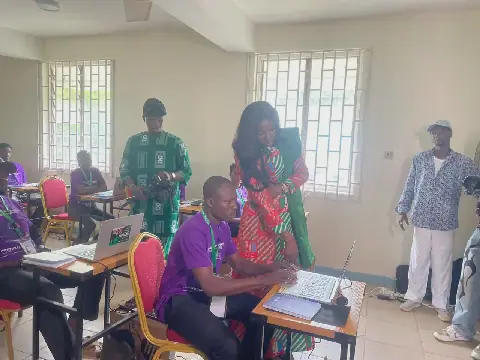
The Democratic Republic of Congo officially launched the mapping operations for its second General Population and Housing Census (RGPH-2) in Kinshasa on September 28. The event, held at the Centre culturel, was presided over by Minister of State for Planning and Development Coordination, Guylain Nyembo. Several government members, Kinshasa city authorities, and representatives from the National Institute of Statistics (INS) and the Bureau Central du Recensement were in attendance.
Over the next month, cartographer agents will traverse Kinshasa's neighborhoods to identify and geolocate buildings, households, and infrastructure, and demarcate census areas. This preparatory phase aims to facilitate a precise national population count scheduled for July 2027. Minister Nyembo emphasized that this mapping stage is crucial for the RGPH-2, enabling the country to have updated, reliable, and territorially accurate data.
These data are essential for better resource allocation, planning schools, healthcare structures, water and electricity access, transportation, and territory development. This marks a significant step in modernizing the national statistical system, 42 years after the first census in 1984. The goal is to reduce reliance on estimates and have reliable statistics to guide public policies and development planning.
INS Director General, Elysée Chovu, highlighted the importance of mapping in census preparation, noting that Kinshasa is the first phase in a process that will be gradually extended to other provinces. She stressed the need for team mobilization and training, adherence to methodologies, and quality control for the process's credibility.
The success of this operation requires everyone's mobilization, with Chovu inviting neighborhood heads to contribute to the operation's success. She encouraged the population to provide a responsible welcome to cartographer agents. Kinshasa's Governor urged the local population to take ownership of the operation and facilitate the agents' work on the ground.
Minister Nyembo called on provincial and local authorities, community and religious leaders, security services, and the population to accompany the teams. He reminded cartographer agents of the requirements for rigor, precision, discipline, impartiality, confidentiality, and gratuity. The process is supported by several technical and financial partners, including the UNFPA.
The RGPH-2 is a statistical and scientific operation, distinct from administrative identification and electoral operations. Its goal is to better understand the population and habitat to inform development planning. Ultimately, the census will cover all individuals living or present on Congolese territory, without distinction.
Key points
- DR Congo starts census mapping in Kinshasa as a crucial step towards the 2027 national population count.
- The mapping phase aims to facilitate a precise national population count scheduled for July 2027.
- The process is supported by several technical and financial partners, including the UNFPA.