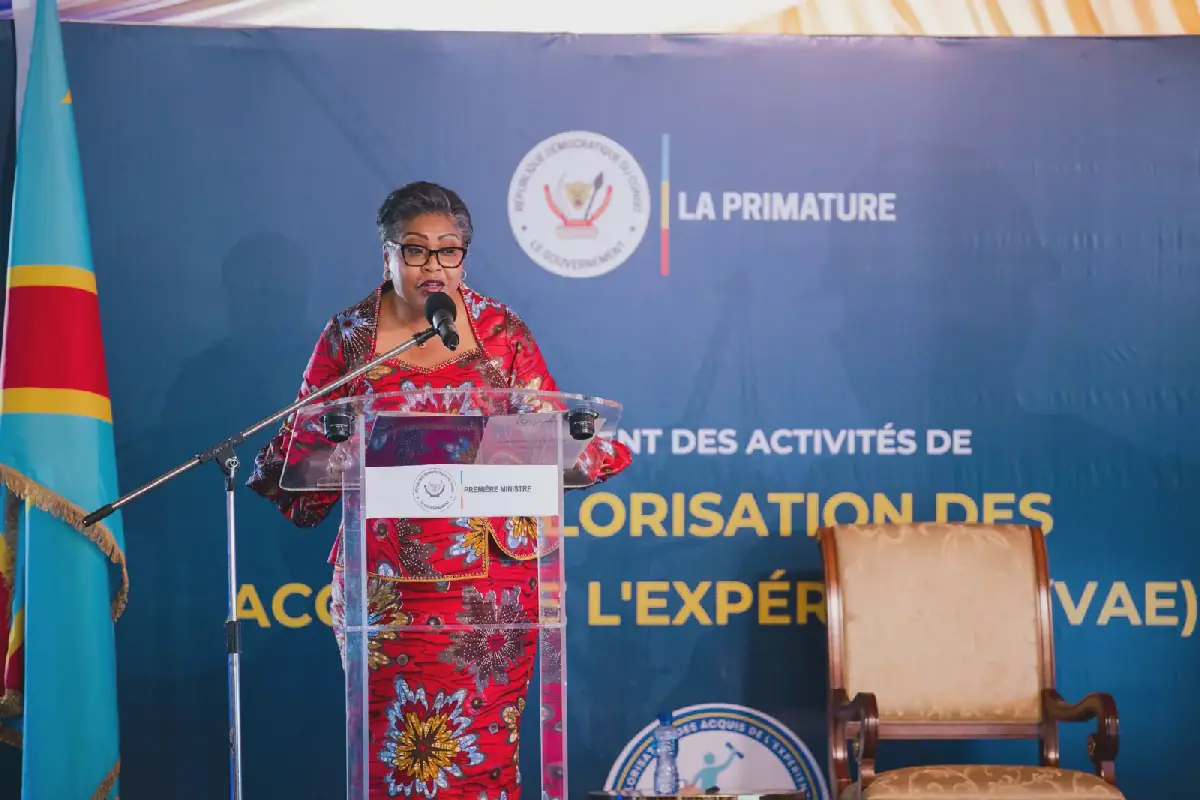
The Democratic Republic of Congo's government, led by Prime Minister Judith Suminwa Tuluka, has initiated a program to integrate informal economy actors into the formal circuit. On November 12, the Prime Minister presided over a ceremony in Kinshasa, where the first activity attestations and entrepreneur cards were awarded. This move aims to administratively recognize the activities of small economic operators and gradually provide them with access to health coverage, financing mechanisms, and entrepreneurial support.
The program seeks to transform the informal economy into a lever for economic growth and social inclusion. Prime Minister Suminwa Tuluka assured informal actors that the formalization process is designed to support their activities, not impose new administrative constraints. She emphasized that formalization should offer new opportunities and open doors to development, rather than creating fear or obstacles. The attestation serves as a first administrative recognition of the economic activities of small traders and artisans.
Over 200,000 informal actors have already been identified, according to Vice Prime Minister and Minister of National Economy, Daniel Mukoko Samba. The government has developed three key instruments: a diagnostic of the informal economy, a national formalization policy, and a national formalization strategy. Mukoko Samba highlighted the need for a gradual approach, adapted to the realities of small entrepreneurs, saying that formalization should be a journey, not a one-time obstacle to overcome.
A significant innovation in this program is the association of the entrepreneur card with access to health coverage, designed to protect beneficiaries against health risks that could compromise their economic activities. Prime Minister Suminwa Tuluka stressed the importance of preserving the capital of small traders, saying that the government does not want their businesses to disappear due to hospital expenses. This articulation between formalization and health protection is seen as a step towards a more inclusive economy.
The effective access to health services is subject to eligibility conditions and coverage modalities defined by competent structures. The government plans to continue this momentum by simplifying administrative procedures, promoting financial inclusion, and providing training and support to small entrepreneurs. This will enable them to evolve into more structured enterprises. The success of this reform will be measured by the concrete changes it produces in the lives of entrepreneurs.
The launch of this program follows a series of efforts to recognize and support informal economy actors in the Democratic Republic of Congo. The government had previously initiated a campaign for the pre-registration of informal economy actors in Kinshasa. The formalization of informal activities is expected to have a positive impact on the country's economy and social development.
The government remains committed to supporting small entrepreneurs and promoting economic growth and social inclusion. The integration of informal economy actors into the formal circuit is a key step towards achieving these goals. As the program continues to unfold, it is expected to have a lasting impact on the lives of thousands of informal actors and their families.
Key points
- Over 200,000 informal actors have been registered in the Democratic Republic of Congo as part of the government's efforts to integrate them into the formal economy.