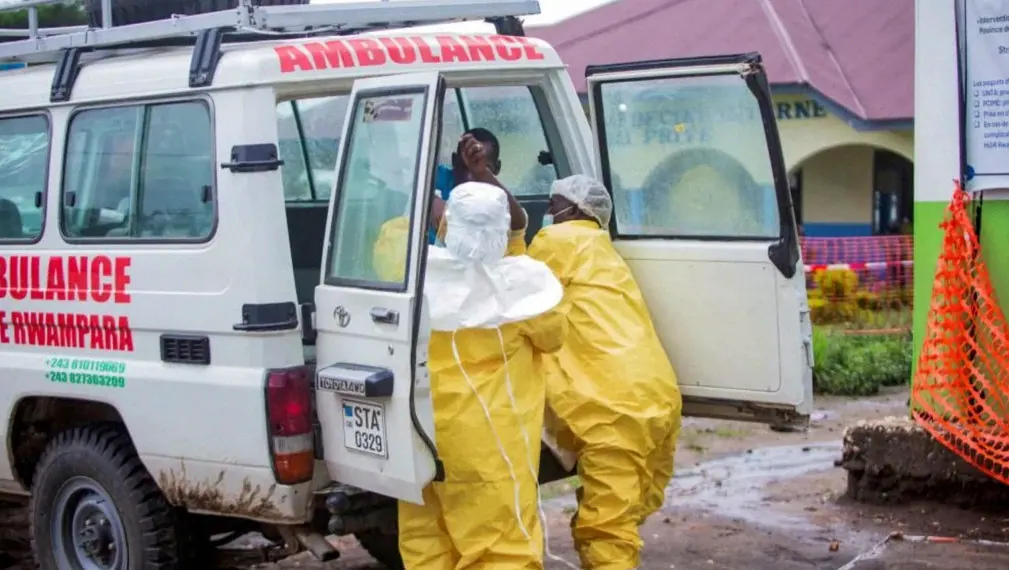
The Ebola outbreak in the Democratic Republic of Congo has expanded further, with two additional health zones reporting cases of the Bundibugyo strain of the virus. According to reports, the newly affected areas are Bulu in Sud Ubangi province and Dungu in Haut-Uele province, which borders South Sudan. This brings the total number of affected health zones to 63, spread across seven provinces.
As of September 23, the World Health Organization reported 7,890 confirmed cases and 3,799 deaths. The outbreak's rapid growth has raised concerns, with the WHO Director-General, Tedros Adhanom Ghebreyesus, emphasizing that the crisis cannot be addressed in isolation from the security situation in eastern and northern DR Congo. Ongoing conflict and displacement are hindering health workers' ability to reach affected communities.
The conflict is complicating containment efforts, with fighting in parts of the country restricting access to certain areas. This makes it difficult for response teams to trace people who may have come into contact with infected individuals. The WHO Director-General warned that restricted access could allow contacts to go untraced, while displacement and overcrowding in areas where people have fled violence increase the risk of transmission.
Despite these challenges, the WHO reports that overall case numbers are declining, and contact tracing, safe burial practices, and community engagement have improved in recent weeks. However, transmission remains uneven across the affected zones. A significant challenge is that there is currently no approved vaccine or treatment specifically for the Bundibugyo strain of Ebola, which could make communities reluctant to seek care at treatment centers.
The WHO is working to accelerate clinical trials for vaccines and treatments targeting this variant of the virus. The Bundibugyo strain differs from the Zaire strain, for which vaccines already exist. For neighboring countries like Ghana, the outbreak remains a distant but closely watched development, with lessons learned from West Africa's experience with the 2014-2016 Ebola epidemic.
Ghana's health authorities have historically monitored such outbreaks for imported risk, although no local transmission has been reported in connection with the current DR Congo crisis. The WHO Director-General also raised concerns about future global health emergencies, emphasizing that while Ebola itself is unlikely to become a pandemic, a respiratory pathogen could pose that risk, and countries need to prepare in advance.
The WHO Director-General pointed to the Pandemic Agreement adopted by the World Health Assembly in May 2025, aimed at strengthening global prevention and preparedness. He also addressed misinformation suggesting the agreement ceded national sovereignty to WHO, calling such claims untrue. The WHO has not given a specific timeline for when the outbreak might be brought under control, but response measures continue across the affected provinces.
Key points
- The Ebola outbreak in DR Congo has spread to 63 health zones across seven provinces, with 3,799 deaths recorded.
- Conflict and displacement are hampering health workers' ability to reach affected communities and trace exposed contacts.
- There is currently no approved vaccine or treatment specifically for the Bundibugyo strain of Ebola.