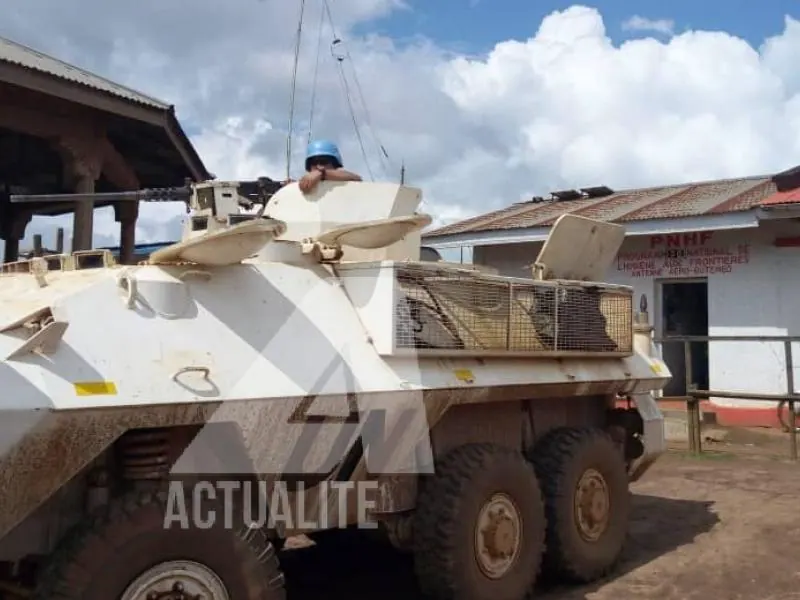
The Democratic Republic of Congo has called for a thorough reevaluation of United Nations peacekeeping operations. This appeal was made during the 10,226th session of the UN Security Council, which focused on the future of peace operations. The session took place under the presidency of France. Kinshasa advocates for an approach that adapts to on-ground realities, with mandates accompanied by adequate resources and permanent partnership with host states.
Nicolas Mupepe Matomene, Minister-Counselor and Deputy Political Coordinator of the DR Congo's Permanent Mission to the UN, represented the country at the session. He emphasized that rationalization should not be confused with automatic reduction of capabilities. "Rationalizing cannot become synonymous with giving up," Matomene stated. He argued that a mission with reduced capabilities is not necessarily more effective if it loses the means to execute its assigned mandate.
The DR Congo believes that the evolution of conflicts requires revisiting traditional peacekeeping concepts. Matomene noted that prolonged conflicts, changing security environments, and scarce resources can lead to measuring a mission's effectiveness solely by reducing its footprint, personnel, or cost. However, he added that the absence of true peace does not justify ending UN presence. The DR Congo stresses that reducing personnel, operational footprint, or costs alone cannot be an indicator of effectiveness.
According to Matomene, the reduction of resources should prompt reflection on the nature of UN presence, the instruments it uses, and its ability to adapt to ground requirements. This would enable more effective contribution to conflict resolution and sustainable peace. The DR Congo's experience has shown that a peace operation's trajectory is never linear. Circumstances can change rapidly, and previously contained threats can resurface.
The DR Congo delegation advocates for responsible, concerted, and reversible transitions when realities on the ground demand it. Matomene emphasized that the real question is not just maintaining peace but enabling UN operations to cover the entire path to peace. This involves a closer articulation between peacekeeping, peace consolidation, prevention, and mediation. Regular evaluation of the situation on the ground should inform a mission's progression and, if necessary, lead to changes in priorities, capabilities, and instruments.
Matomene cited the experience of the MONUSCO mission, which has supported the Expanded Joint Verification Mechanism as part of regional efforts to monitor the ceasefire. This illustrates how an existing operation can utilize its capabilities, expertise, and presence to serve a broader political and regional architecture. He stressed the central role of the host state, emphasizing that their consent should not be a mere formality but a guiding principle throughout a mission's life.
The DR Congo's call for adaptable peacekeeping mandates and adequate resources reflects its experience hosting one of the oldest UN peacekeeping missions. The UN Security Council adopted Resolution 2808 in December 2025, renewing the MONUSCO mandate for another year. The DR Congo's delegation underscores the importance of reconciling adopted mandates with necessary resources for their implementation.
Key points
- DR Congo urges UN to adapt peacekeeping mandates to ground realities and provide sufficient resources.
- Rationalization of peacekeeping operations should not be confused with automatic reduction of capabilities.
- The role of the host state is central to the success of peacekeeping missions.