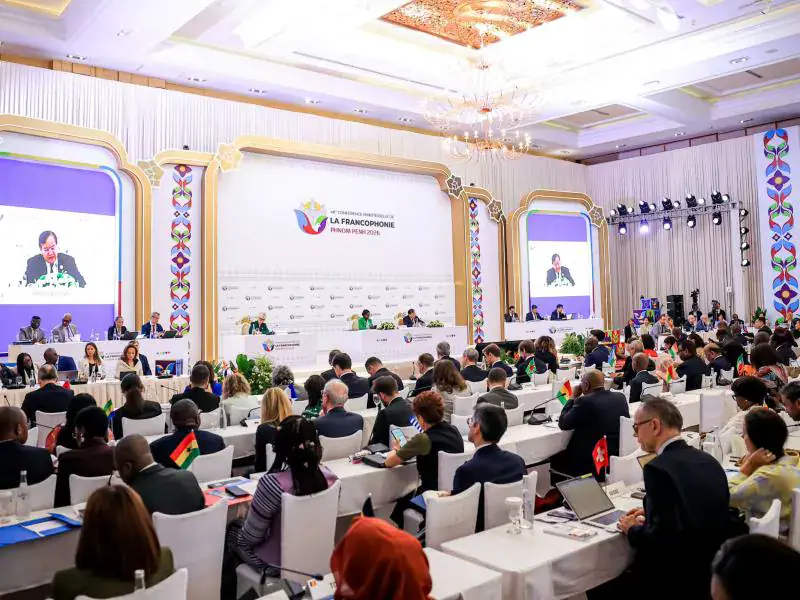
The 20th Summit of the Organisation internationale de la Francophonie (OIF) is set to take place in Phnom Penh, Cambodia, from November 14 to 16, 2026. The summit, themed "Réinvestir dans la paix pour une prospérité partagée et une stabilité durable" (Reinvesting in peace for shared prosperity and sustainable stability), will bring together representatives from 90 member states and governments. They will define the OIF's priorities for the next four years, until 2030.
Thérèse Kayikwamba Wagner, Minister of State for Foreign Affairs, International Cooperation, Francophonie, and Congolese Diaspora, arrived in Phnom Penh on November 13, 2026, to participate in the summit. She was welcomed by Sam Ath Sambath Sreysour, Under-Secretary of State for Foreign Affairs and International Cooperation of Cambodia. Before the summit, Wagner will attend the 48th session of the Francophonie Ministerial Conference on November 14, 2026.
The ministerial conference will discuss priorities for multilateral cooperation, peace, and stability within the Francophonie, as well as preparations for the 20th Francophonie Summit. The conference will also examine several political and cooperation dossiers, and draft texts to be submitted to heads of state and government. The election of the OIF Secretary-General for the next four years is scheduled for November 16, 2026.
Four candidates are vying for the position: incumbent Rwandan Secretary-General Louise Mushikiwabo, who is seeking a third term; Juliana Lumumba, former Congolese minister and daughter of Patrice Emery Lumumba; Mauritanian Minister-Coordinator and Special Envoy Dr. Coumba Ba; and former Romanian Prime Minister Dacian Cioloș. This stage of the summit takes place against a backdrop of intense diplomatic competition, particularly surrounding the candidatures supported by the Democratic Republic of Congo and Rwanda.
The conflict between Kinshasa and Kigali has been ongoing for several years, with tensions linked to security accusations. According to political analyst Christian Moleka, the crisis has already played out in the UN Human Rights Council and Security Council. Moleka sees the Francophonie as a new arena for confrontation between the DR Congo and Rwanda, describing it as a "metastasis" of the crisis.
Moleka believes that the Congolese strategy at the OIF appears to be more focused on countering Rwanda than promoting Juliana Lumumba's candidacy. He regrets that the country did not capitalize on the momentum of the 2023 Francophonie Games to prepare a solid candidacy. Moleka also notes that French President Emmanuel Macron's initiative to ask Rwandan President Paul Kagame to withdraw Mushikiwabo's candidacy in favor of Cioloș indicates Paris's embarrassment.
DR Congo's Foreign Minister Thérèse Kayikwamba Wagner has stated that her country may withdraw from the OIF if it does not align with the country's values and priorities. Wagner mentioned that the DR Congo plans to withdraw from around a dozen organizations by the end of 2026 that no longer align with its priorities. The country is also seeking to redefine its relationships with international organizations.
Key points
- The 20th Francophonie Summit will define the organization's priorities until 2030.
- The summit takes place amid diplomatic tensions between the DR Congo and Rwanda.
- The DR Congo may withdraw from the OIF if it does not align with the country's values and priorities.