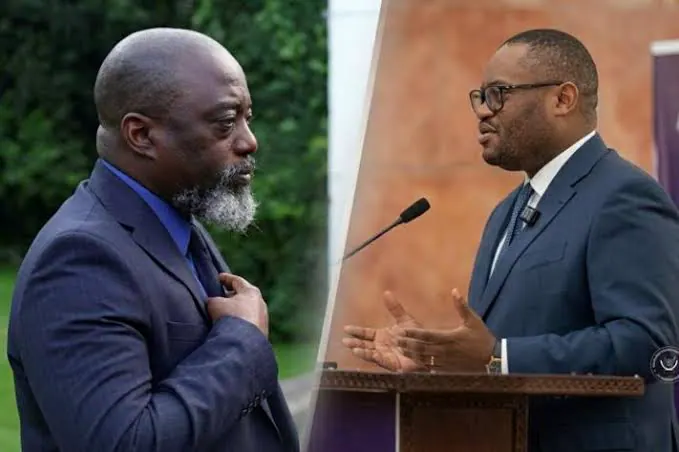
On October 10, 2026, Democratic Republic of Congo's Finance Minister Doudou Fwamba took to social media to address concerns raised by former President Joseph Kabila about the country's debt. Kabila had claimed that the public debt had "exploded" to over $18 billion, surpassing the burden inherited from previous regimes. Fwamba sought to clarify the situation, stating that while managing public debt is crucial, using it as a financing tool for infrastructure and government priorities while maintaining sustainability is a sign of coherent public action and strategic vision.
Fwamba pointed out that Kabila's assertion that a 20% debt-to-GDP ratio is a burden for the DRC is unfounded. He noted that countries in Sub-Saharan Africa have an average debt-to-GDP ratio of 60%, making the DRC's ratio relatively low. The minister emphasized that such claims are either driven by political bad faith, a lack of understanding of economic fundamentals, or a lack of strategic vision for development financing.
The minister also addressed Kabila's legacy, stating that the former president was in denial about the economic situation he left behind in 2019. Fwamba recalled that in 2019, the DRC had a nominal GDP of around $50 billion, $1.3 billion in foreign exchange reserves, a budget of $4 billion, and a current account deficit of -3.2% of GDP. He contrasted this with the current situation, where the DRC has a nominal GDP of $120 billion, $8 billion in foreign exchange reserves, a budget of $18 billion, and a reduced current account deficit of -1.3% of GDP.
Fwamba highlighted significant progress made under the current administration, including increased access to international capital markets and three formal programs with the International Monetary Fund. He attributed the lack of transparency and failure to publish contracts with state-owned mining companies during Kabila's tenure as reasons for the DRC being denied a formal IMF program.
The minister also compared the social and economic landscape of 2019 to the present day, noting significant improvements. He mentioned the introduction of free primary education, free maternity care, and a healthcare insurance system for university professors and magistrates. Additionally, Fwamba pointed to the construction of modern universities, new airport runways, administrative buildings, and asphalted roads in various regions.
Fwamba called on all Congolese citizens to join the national dialogue initiated by President Félix Tshisekedi, urging those bearing arms to disarm and engage in peaceful discussions. He emphasized that expressing dissent does not require violence and encouraged citizens to work towards a united and indivisible Congo.
The minister concluded by highlighting the country's progress and ongoing efforts to rebuild and transform the nation. He invited all Congolese to participate in this process, emphasizing the importance of peace and dialogue in achieving this goal.
Key points
- Doudou Fwamba disputes Joseph Kabila's claims that the DRC's debt is a burden.
- The DRC's debt-to-GDP ratio is around 20%, relatively low compared to other Sub-Saharan African countries.
- Fwamba calls for national dialogue and peaceful resolution of conflicts.