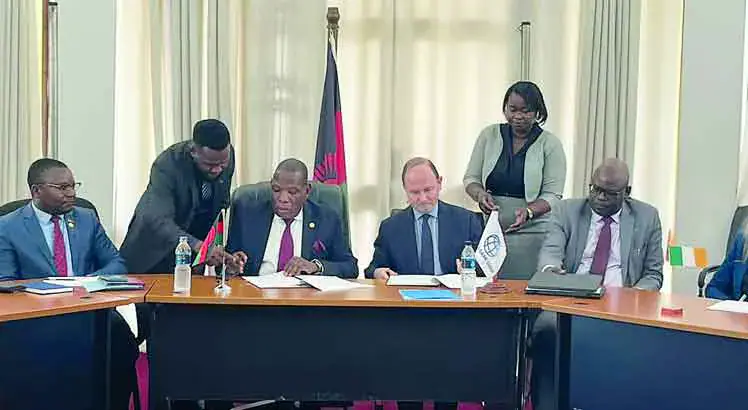
Malawi's development partners have committed $221 million to support the country's economic recovery and social protection programs. The funds, equivalent to about K414 billion, will be disbursed soon after the signing of financing agreements in Lilongwe. The World Bank, European Union, United Kingdom, Germany, Ireland, and Iceland are involved in the financing. This commitment signals confidence in Malawi's reform agenda despite ongoing fuel shortages and foreign exchange constraints.
The financing will support two projects under the government's National Economic Recovery Plan (NERP). The Transforming High-Potential Resilient Value Chains (M-THRiVE) project aims to stimulate business growth, particularly among small and medium enterprises in export value chains. The Integrated Social Protection for Resilience and Opportunity (INSPIRE-O) project will strengthen social protection and create economic opportunities for vulnerable households across the country's 25 districts and four cities.
The $165.9 million INSPIRE-O project will combine direct assistance with climate-smart public works and economic inclusion programs targeting women and young people. It will also strengthen responses to climate-related shocks in 10 drought-prone districts. This project is expected to have a positive impact on the lives of many Malawians, especially those in vulnerable communities.
Despite persistent fuel queues and foreign exchange shortages, development partners remain confident in Malawi's recovery efforts. They cite the government's commitment to reforms, export expansion, and private sector development as reasons for their optimism. World Bank country manager Firas Raad emphasized the need for sustained economic reforms and implementation of NERP.
Raad also noted that Malawi's foreign exchange challenges are structural and require long-term solutions, particularly improved export performance. He cited Zambia and Zimbabwe as examples of countries that have undergone difficult economic adjustments and recovered with sustained commitment to reforms. The World Bank's financing is guided by accountability safeguards and expected development impact.
Ireland's Ambassador to Malawi, Kate Brady, acknowledged the economic challenges but expressed donors' confidence in the government's efforts to address them. She said partners are particularly interested in supporting export development, private sector investment, and programs protecting vulnerable populations. Minister of Finance, Economic Planning and Decentralisation Joseph Mwanamvekha described the agreements as evidence of growing confidence in President Peter Mutharika's administration and its reform agenda.
Mwanamvekha cautioned against relying on external assistance to resolve Malawi's foreign exchange problems, emphasizing the need to expand exports to build reserves. Raad also stressed the importance of diversifying foreign exchange sources, including export earnings, foreign direct investment, remittances, and foreign aid. The $221 million commitment is equivalent to about one month's import cover.
Key points
- Donors pledge $221 million to support Malawi's economic recovery and social protection programs.
- The financing will support two projects under the government's National Economic Recovery Plan (NERP).
- Development partners remain confident in Malawi's recovery efforts despite ongoing fuel shortages and foreign exchange constraints.
Reporting sources
- Donors commit K414bn to Malawi recovery · The Nation