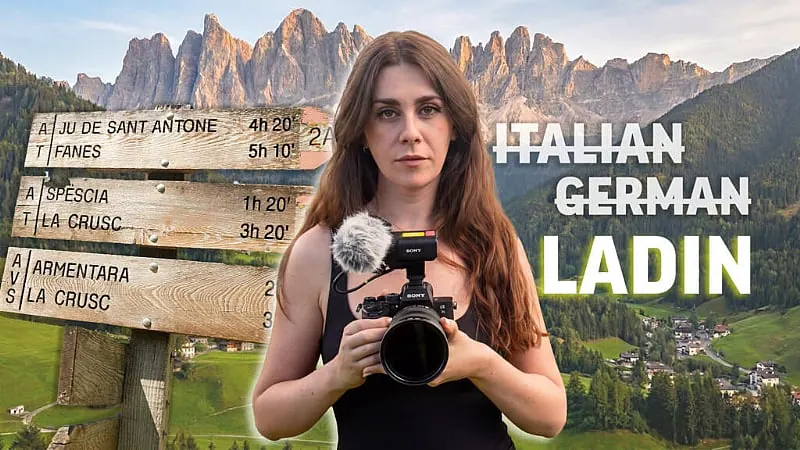
The Dolomites, a mountain range in northern Italy, has become a highly popular destination for tourists, welcoming several million visitors every year. However, this growing influx of visitors worries locals, who fear that it may force young people to leave their homes for financial reasons. Marco, a 29-year-old graphic designer from the Badia Valley, expressed concerns about the impact of tourism on the community. His brother Samuel, a 32-year-old pharmacist, shares similar concerns, emphasizing the need to preserve their community.
The community in question is the Ladin community, comprising about 30,000 people living in five valleys across the Italian regions of Trentino Alto-Adige and Veneto. Most of these Italians speak both German and Italian, but they also speak Ladin, one of the last living alpine languages and one of the oldest in Europe. Ladin is an integral part of daily life in these valleys, used in schools, at home, and at work. According to Samuel, Ladin is the majority language in the valleys and can be hardly understandable to tourists, even Italian ones.
Despite its importance, Ladin is often misunderstood by outsiders. Samuel recounted instances where tourists or locals would ask, "Why do you speak that language? Speak Italian, no?" However, the Ladin language has been preserved and promoted through the autonomous status granted to the region in 1972. The decree guarantees Italian/German bilingualism and places particular emphasis on the teaching of Ladin. As a result, Ladin is used in nursery schools and taught in primary schools in Ladin-speaking areas.
The Ladin valleys have a system of trilingual schools, where classes are taught in Italian and German, and Ladin is used as the everyday language. This approach has helped to keep the language alive, with many locals making a conscious effort to preserve it. Samuel, a fervent defender of his mother tongue, believes that enjoying the language is key to its survival. He and his friends formed a rap group, Cooperaziun Planta, which performs exclusively in Ladin.
The rap group's efforts are part of a broader movement to promote and preserve the Ladin language. By using Ladin in creative and modern ways, such as through rap music, the community hopes to keep the language relevant and engaging for younger generations. This approach has proven effective, as Ladin continues to be an integral part of daily life in the Dolomites.
However, the growing tourism industry poses a significant challenge to the community's efforts to preserve their language and culture. As prices skyrocket and locals are forced to leave their land, the community risks being displaced or assimilated. Marco and Samuel emphasize the need to find a balance between economic development and cultural preservation.
Ultimately, the Ladin community's determination to preserve their language and culture is driven by a desire to maintain their unique identity and way of life. By promoting Ladin through education, creative expression, and community engagement, they hope to ensure the language's survival for generations to come. As Elena Pompei, an ENTR journalist, discovered during her visit to the Dolomites, the Ladin language is a vital part of the region's heritage and a source of pride for its people.
Key points
- The Ladin language is one of the last living alpine languages and a vital part of the Dolomites' cultural heritage.