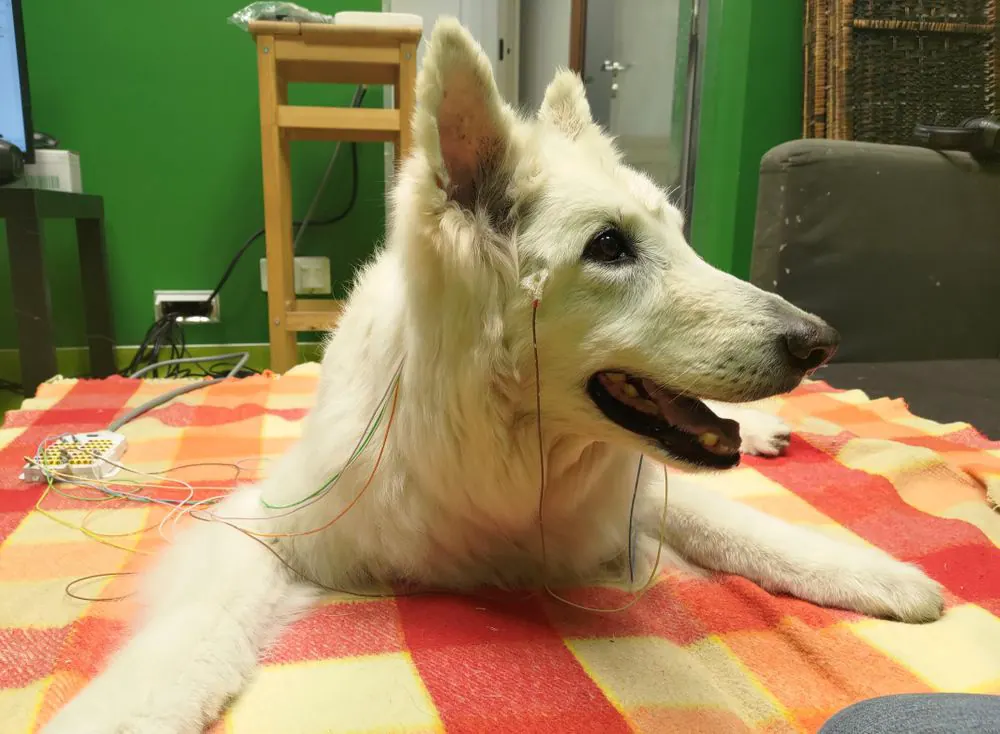
A recent study published in the journal Science has found that dogs use a similar strategy to human infants to pick out words in streams of speech. The research, conducted by cognitive neuroscientist Attila Andics and his team at Eotvos Lorand University in Budapest, discovered that dogs listen for consonants to figure out when one word ends and another begins. This is known as the consonant bias. The study suggests that dogs may have developed this ability through domestication.
The researchers tested 20 dogs and 20 humans in a lab, playing streams of nonsense words with different patterns for them. The EEG data collected showed that both dogs and humans had increased brain activity with consonant patterns. Interestingly, this was also true for dogs that had not been exposed to speech until later in life. The study's findings shed new light on language evolution and suggest that speech can shape the brains of animals that don't have complex language abilities.
The research contributes to a growing body of evidence that dogs are attuned to language in a way similar to young humans. According to Francys Subiaul, a cognitive scientist at George Washington University, dogs have developed the ability to identify words and their meanings, much like human babies. Subiaul notes that dogs are highly attuned to humans and that their experiences shape their brains in similar ways to how they shape the brains of human babies.
One question that arises is whether dogs' ability to understand human language is a result of domestication over the last 15,000 years or an innate ability. Subiaul suggests that a study with wolves could provide the answer. However, he suspects that wolves may not develop the same abilities as dogs, given the powerful force of domestication in shaping their behavior and brain function.
Previous studies have shown that contact between dogs and humans increases oxytocin, the bonding hormone, in both species. Subiaul believes that this is a result of domestication and that it has made dogs and humans highly attuned to each other. He also notes that dogs are more sensitive to human social cues, such as eye gaze and pointing, than primates are.
While the study's findings are intriguing, more research is needed to confirm the results and fully understand how dogs developed this ability. Amritha Mallikarjun, a postdoctoral research associate at Harvard University, notes that the study adds to our understanding of the long history between humans and dogs and how their experiences have shaped each other's brains.
The study's authors hope that their research will contribute to a deeper understanding of the complex relationship between humans and dogs. As Subiaul notes, dogs seem to be more emotionally attuned to humans than other animals, and this may be a key factor in their ability to understand human language.
Key points
- Dogs use consonant bias to segment words in speech, similar to human infants.
- The ability may have developed through domestication over the last 15,000 years.
- Further research is needed to confirm the findings and understand how dogs developed this ability.