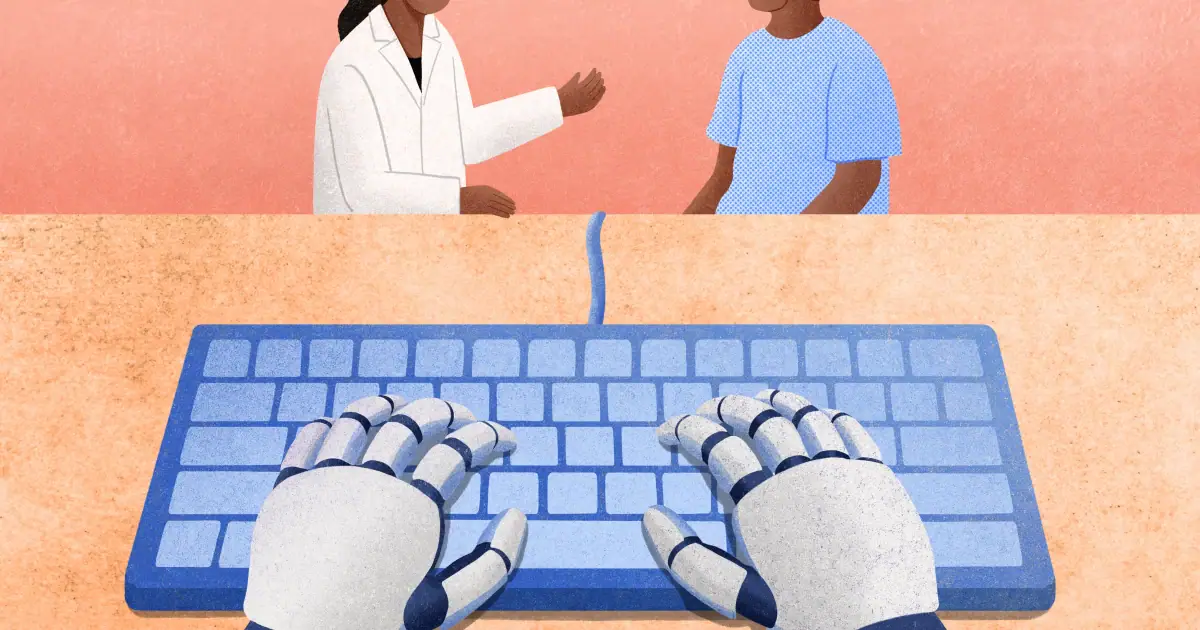
Dr. Mara Gordon, a family physician in Camden, New Jersey, has started using an artificial intelligence scribe to take notes during patient consultations. The AI scribe uses automatic speech recognition technology to record conversations and distinguish between the doctor's and patient's voices. This technology has become increasingly popular in medicine, with doctors using it to take notes in various settings, from primary care to emergency rooms. Dr. Gordon admits to being an eager adopter of this technology in her own practice.
The AI scribe app Dr. Gordon uses is downloaded on her personal smartphone, and she sets it down on the desk in the exam room during consultations. The recording is then transcribed, and a large language model converts the raw transcript into a medical note. These notes follow a standard format specific to the specialty and type of visit, reflecting what the patient told the doctor, physical exam findings, and the doctor's medical decision-making. Dr. Gordon appreciates that the AI scribe helps her focus more fully on her patients.
Despite the benefits, Dr. Gordon acknowledges concerns about privacy and the potential impact on the doctor-patient relationship. She worries that corporate health systems might pressure doctors to use the time saved with AI scribes to see more patients. Additionally, Dr. Gordon is concerned that AI might one day replace human doctors. To alleviate some of these concerns, most AI scribe systems are HIPAA-compliant, ensuring that patient data is protected and safeguarded at every step of the process.
However, AI scribes can make mistakes, as Dr. Gordon has experienced firsthand. In one instance, the AI scribe incorrectly noted that a patient had been misdiagnosed. Dr. Gordon often catches other errors, such as mistaking a patient's gender or age. These scribes can also mistake "I do" statements with "I do not," which can be critical in medical consultations. Dr. Eileen Kim, an assistant professor of internal medicine at the University of California San Diego, shares Dr. Gordon's concerns about AI scribes propagating errors throughout medical records.
Dr. Kim specializes in clinical informatics and thinks about how AI might shape the future of medicine. She notes that doctors are often overburdened and may not have time to adequately review AI-generated notes, which can lead to errors. As a result, Dr. Gordon always reads AI-generated notes carefully before adding them to the medical record. Most AI scribe software requires doctors to sign a user agreement stating they are liable for everything written in the medical record, even if an AI scribe helps with it.
Despite the potential risks, Dr. Gordon is happy to have AI help with administrative tasks, allowing her to focus on being a human doctor with human intelligence. She still takes pride in her work and often edits AI-generated notes to make her clinical decision-making more clear. As AI technology continues to evolve, it is essential to consider its implications on medical consultations and patient care.
The use of AI scribes raises important questions about the future of medicine and the role of technology in patient care. While AI can help with administrative tasks, it is crucial to ensure that it does not compromise patient care or the doctor-patient relationship. As Dr. Gordon and others continue to explore the benefits and risks of AI notetakers, it is essential to prioritize patient care and ensure that technology is used in a way that complements and enhances medical consultations.
Key points
- AI scribes are becoming increasingly popular in medicine, but they can make mistakes and raise concerns about privacy and liability.
- Doctors are ultimately responsible for the content of AI-generated notes and must review them carefully before adding them to medical records.
- The use of AI scribes raises important questions about the future of medicine and the role of technology in patient care.