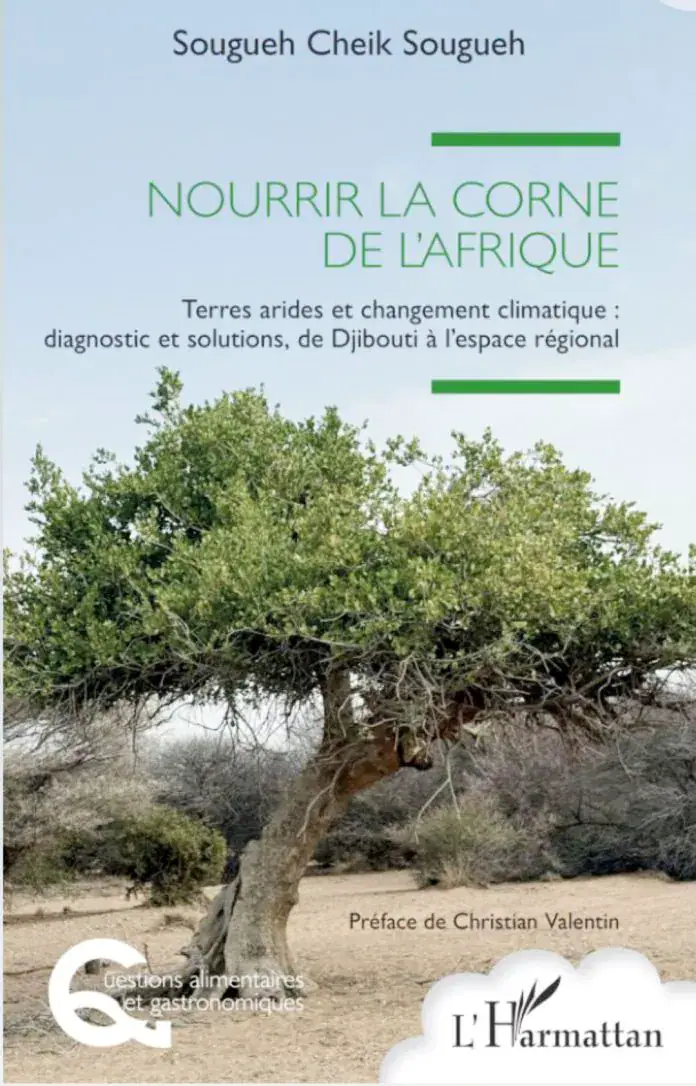
Djiboutian researcher Sougueh Cheik Sougueh has recently published a book titled "Nourrir la Corne de l’Afrique" (Feeding the Horn of Africa), which examines the food security challenges facing the region. The 275-page book, published by l'Harmattan, offers a scientific approach to addressing the issues of land degradation, natural resource management, and regional cooperation. Sougueh's work is centered on the intersection of agronomy, soil science, and development, providing concrete solutions to restore degraded lands and promote sustainable agriculture.
The book begins with a striking image of an abandoned agricultural plot in southern Djibouti, which was once used for growing tomatoes and okra. The land has become almost unproductive due to soil salinization caused by poor irrigation practices. This scene sets the tone for the author's exploration of the broader challenges facing the Horn of Africa, including climate change, recurrent droughts, and fragile ecosystems. Sougueh argues that food security can only be achieved by understanding the realities on the ground, including soil conditions, water management, and community capacities.
One of the key contributions of Sougueh's book is its focus on the soil as the primary territory of food security. In the Horn of Africa, where rainfall is scarce, temperatures are high, and evapotranspiration is significant, soil degradation is a major constraint to agricultural productivity. Djibouti, in particular, imports most of its food and has limited agricultural resources, making it a critical case study. However, Sougueh does not see this situation as irreversible, instead advocating for a better understanding of land potential, limitations, and restoration conditions.
The author challenges the common perception that Africa has vast unused agricultural resources and can easily feed itself. He notes that available land may not be fertile, accessible, or immediately cultivable, and that many areas are already used for grazing, forestry, or other purposes. This paradox highlights the complexities of African agriculture, where a young population, significant employment in the sector, and substantial natural potential coexist with dependence on food imports. This dependence exposes national economies to international market fluctuations, as seen in the 2008 and 2022 food price crises.
Sougueh's book is notable for its interdisciplinary approach, combining pedology, agricultural production, livestock management, nutrition, poverty, and governance. This comprehensive perspective allows for an understanding of food security as a multifaceted issue that cannot be reduced to simply increasing yields. The author emphasizes the importance of factors such as water availability, land health, agricultural practices, market access, community rights, and institutional quality in achieving sustainable food security.
The book is based on over a decade of field observations, sampling, measurements, and interactions with farmers and herders in arid regions. Sougueh advocates for a dialogue between scientific knowledge and local empirical knowledge, recognizing that rural communities have developed valuable insights into their environment and its constraints over generations. This approach underpins the solutions proposed, which focus on restoring degraded lands, improving water management, preserving soil fertility, and adapting agricultural practices to climate conditions.
Ultimately, Sougueh's work offers a nuanced perspective on food security in the Horn of Africa, one that balances scientific rigor with practical experience and community engagement. By exploring the complexities of sustainable agriculture in the region, the book provides valuable insights for policymakers, researchers, and practitioners seeking to address the challenges of food security and environmental sustainability in this critical part of Africa.
Key points
- The book "Nourrir la Corne de l’Afrique" offers a scientific approach to addressing food security challenges in the Horn of Africa, focusing on sustainable solutions to land degradation and environmental issues.