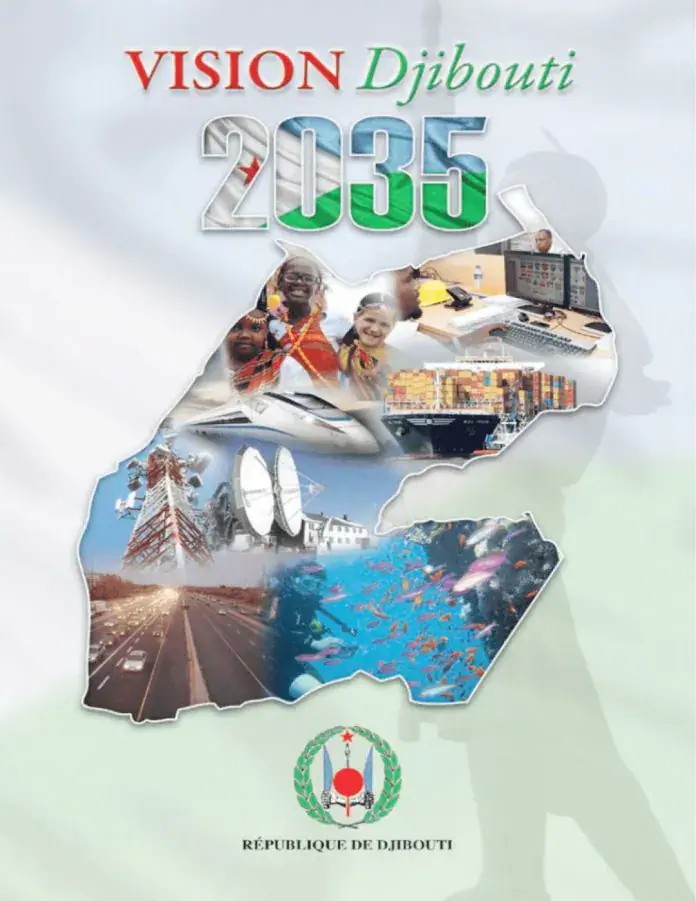
Djibouti's Vision 2035, launched in 2016, has led to significant transformations in the country over the past decade. The country's ports have modernized, infrastructure has expanded, and digital connectivity has strengthened considerably. As a result, Djibouti has established itself as a leading logistics platform in the Horn of Africa. However, the challenge remains to convert this geographical advantage into a diversified economy that generates more jobs, added value, and shared prosperity.
The Vision 2035 strategy focuses on transforming Djibouti into a regional and continental economic hub while improving living standards. It aims to overcome the limitations of a small economy with a narrow domestic market, high dependence on imports, and a concentration of activity around services, ports, and geostrategic position. The strategy emphasizes a diversified and competitive economy, private sector development, human capital, regional integration, new technologies, agriculture, fishing, livestock, tourism, and industry.
Between 2013 and 2024, Djibouti's GDP doubled, and its infrastructure and productive sectors underwent significant transformations. A major achievement has been making Djibouti a regional hub, particularly in port infrastructure and logistics. The country has invested heavily in its ports, free zones, transport corridors, and connection infrastructure with Ethiopia's hinterland. This strategy has enabled Djibouti to consolidate its role as Ethiopia's maritime gateway and transit platform between Asia, the Middle East, Africa, and Europe.
The International Monetary Fund (IMF) estimated that Djibouti's growth exceeded 6.5% in 2024, driven by an increase in port activity and a rebound in construction, trade, telecommunications, and tourism. Transshipment has also increased significantly, despite navigation disruptions in the Red Sea. The port is no longer just a national infrastructure but a strategic regional asset. However, this success also presents a paradox: the more Djibouti becomes efficient in logistics, the more it must avoid being locked into an economic model based essentially on its location.
Investments over the past decade have not only focused on ports but also on transportation, telecommunications, energy, economic and industrial zones, and urban infrastructure. This policy has created the material conditions for a more open and integrated economy. In the digital sector, Djibouti has an exceptional asset: eight operational submarine cables connecting the country to major data networks between Asia, Europe, and Africa. The potential for developing data centers and digital services has become a credible component of economic diversification.
The next step is to go beyond mere data transit and make Djibouti a producer of digital services, a regional data center, a hub for technology companies, an innovation laboratory, and a digital hub for the Horn of Africa. Regional integration remains a key driver of growth, and Djibouti's natural infrastructure can serve a much larger market than its domestic market. The challenge is to develop industrial, commercial, processing, and service activities around logistics corridors.
The preparation of the 2025-2030 National Development Plan (PND) is a crucial step, with priorities including economic diversification, agriculture, digitalization, tourism, human capital, sustainable development, climate resilience, governance, and improving the business environment. This new generation of public policies marks a change in approach, shifting from building physical foundations for emergence to transforming these foundations into national wealth. The real indicator of success will be the number of businesses created, decent jobs generated, young people trained and employed, locally produced and transformed products, exported services, and additional income distributed in the national economy.
Key points
- Djibouti's Vision 2035 aims to transform the country's geographical advantage into a diversified economy.
- The strategy focuses on regional integration, digitalization, and private sector development.
- The country has made significant progress in infrastructure development, but the next challenge is to create jobs and shared prosperity.