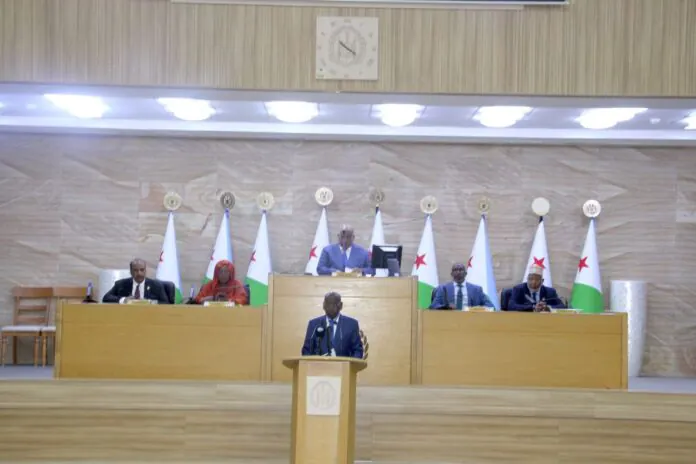
The National Assembly of Djibouti convened on Thursday, October 4, 2026, for the second ordinary session of the year. The session was attended by President of the National Assembly, Dileita Mohamed Dileita, and Prime Minister, Abdoulkader Kamil Mohamed, along with members of the government, parliament, and high-ranking officials. The session began with the swearing-in of new deputy Abdoulkader Houssein Ahmed, who replaced the late Djama Guedi Aden.
In his opening speech, President Dileita Mohamed Dileita emphasized the importance of the upcoming parliamentary work, particularly the examination of the 2027 budget. He stressed that the budget is a crucial instrument for implementing economic and social policies and improving public action. The president also highlighted the need for parliamentarians to take responsibility in examining, controlling, and adopting the state budget.
Prime Minister Abdoulkader Kamil Mohamed presented the main orientations of the 2027 budget, which is based on a projected GDP growth of 7%. The budget forecasts total revenues of 161.3 billion FDJ and expenditures of 160.5 billion FDJ, resulting in a slight surplus of less than 1 billion FDJ. The prime minister explained that this projection takes into account the regional and international context.
The 2027 budget also focuses on strengthening domestic revenue, with estimated fiscal revenues of 103.8 billion FDJ, representing a 14% increase compared to the revised 2026 budget. Non-fiscal revenues are expected to decline from 54.7 billion FDJ to 44.6 billion FDJ, while donations will remain relatively stable at 12.9 billion FDJ.
The government's budget strategy also aims to reduce the public debt ratio to GDP, which is expected to decrease from 64.4% in 2025 to 54.6% in 2027 and 37.9% in 2029. The government plans to achieve this through a multi-year programming approach, with a focus on investment and a selection of projects that will have a tangible impact on the economy.
The new government's action plan is based on four strategic axes: economic growth and diversification, human capital and social cohesion, governance, performance, and accountability, and investment. The prime minister emphasized the need for better alignment of financing with actual results obtained.
The session also highlighted Djibouti's commitment to hosting refugees, particularly from Yemen, and the need for international solidarity to address the humanitarian crisis. The president of the National Assembly called for the international community to work towards protecting civilians and respecting human rights in Yemen and Palestine.
Key points
- Djibouti's parliament has opened its second ordinary session of 2026, focusing on the 2027 budget and governance reform.
- The 2027 budget is based on a projected GDP growth of 7% and aims to strengthen domestic revenue and reduce the public debt ratio.
- The government's action plan focuses on economic growth, human capital, governance, and investment.