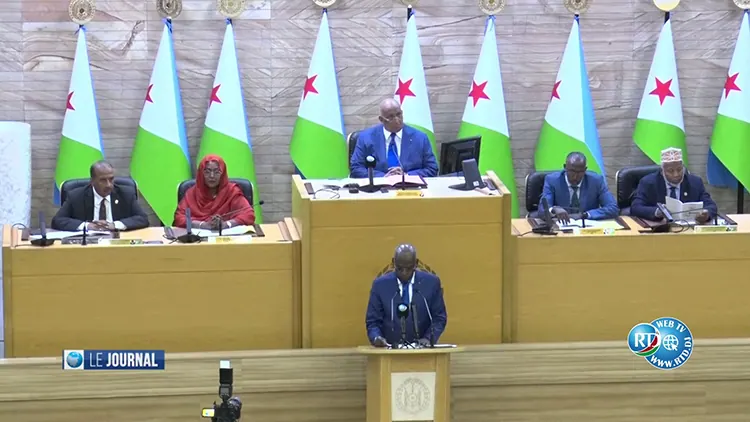
On October 1, 2026, Djibouti's National Assembly President Dileita Mohamed Dileita officially opened the second ordinary session of the year. The ceremony was attended by Prime Minister Abdoulkader Kamil Mohamed, government members, parliamentarians, and representatives from various institutions, diplomatic corps, and international organizations. The event marked the resumption of the national representation's work, following the constitutional provisions governing the Parliament's organization and functioning.
During the opening session, Deputy Abdoulkader Houssein Ahmed was admitted to replace the late Djama Guedi Aden. The National Assembly paid tribute to Aden, who had passed away. In his address, President Dileita highlighted the institutional significance of the second ordinary session, which initiates a new sequence of legislative activity. He emphasized the session's budgetary focus, where parliamentarians will examine the finance bill and exercise their oversight, examination, and proposal powers.
President Dileita stressed that parliamentary authorization of state resources and expenditures is a fundamental prerogative of the national representation. This process allows parliamentarians to assess budgetary policy orientations, examine their coherence with national economic and social priorities, and ensure proper public resource allocation. Prime Minister Abdoulkader Kamil Mohamed subsequently presented the 2027 budget policy's main orientations, focusing on preserving financial balances, transparent public fund management, and improved administration performance.
The Prime Minister's presentation outlined a 7% GDP growth projection for 2027, with estimated revenues of 161.3 billion FDJ and expenditures of 160.5 billion FDJ. He emphasized continued public investment efforts and the government's desire to diversify the national economy, prioritizing human capital, youth employment, vocational training, and digitalization. The situation resulting from the Yemen conflict was a major point of convergence in the President and Prime Minister's interventions.
President Dileita commended the mobilization of national institutions, defense and security forces, international organizations, and civil society in supporting Yemeni populations arriving in Djibouti, particularly in the Obock region. He called for sustained solidarity and support for the efforts undertaken by the Republic of Djibouti. The Prime Minister highlighted Djibouti's role as a land of peace, hospitality, and solidarity, with over 3,000 displaced persons from Yemen having arrived in the country.
The parliamentary session's opening marks a new phase in legislative work and government action oversight. President Dileita reminded parliamentarians that their mandate must prioritize the general interest and consider the aspirations of the Djiboutian people. The solemn session concluded in a convivial atmosphere, with the President inviting guests to a moment of exchange and fraternity in the honor hall.
As the session progresses, parliamentarians will focus on the finance bill and other legislative priorities. The National Assembly's work will be guided by the principles of transparency, accountability, and the well-being of the Djiboutian people. The session's outcome will have significant implications for the country's economic and social development.
Key points
- The National Assembly's second ordinary session focuses on the 2027 budget and legislative priorities.
- President Dileita emphasizes the importance of parliamentary oversight and budgetary policy coherence.
- The session also highlights Djibouti's response to the Yemen conflict and its commitment to solidarity and humanitarian support.