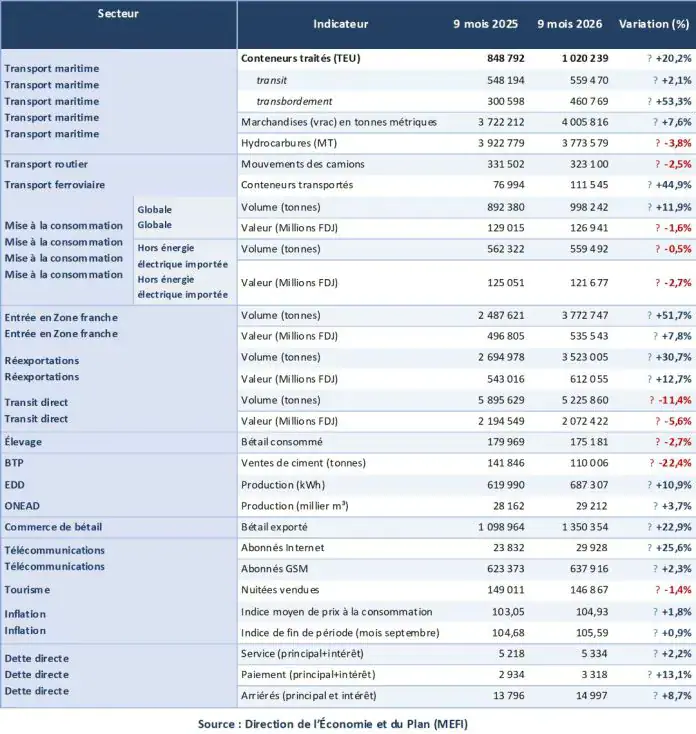
Djibouti's economy has demonstrated remarkable performance in the first nine months of 2026, according to data from the Ministry of Economy and Finance's Directorate of Economy and Planning. The country's strategic sectors have recorded significant growth, confirming its position as a major economic hub in the region. The port sector, a key driver of the economy, has seen a 20.2% increase in container traffic, with over 1 million containers handled, up from 848,792 in the same period of 2025.
The port of Djibouti has also seen a significant increase in transshipment, with a 53.3% rise, and a 7.6% increase in bulk cargo. These results highlight Djibouti's role as a major logistics platform, connecting regional and international trade. The country's rail transport sector has also experienced significant growth, with a 44.9% increase in container transport, reaching 111,545 containers, up from 76,994 in the same period of 2025. This growth underscores the importance of rail infrastructure in the national and regional logistics chain.
Djibouti's free zones have also recorded exceptional growth, with a 51.7% increase in incoming goods. The country's re-export activities have also seen a significant increase, with a 30.7% rise in volume and a 12.7% increase in value. These results demonstrate the dynamism of Djibouti's commercial activities and its attractiveness as a transit, storage, and redistribution platform for goods.
The energy, water, and telecommunications sectors have also shown positive growth. Electricity production has increased by 10.9%, while water production by the National Water and Electricity Company (ONEAD) has risen by 3.7%. The telecommunications sector has seen a significant increase in internet subscribers, with a 25.6% rise, reaching 29,928 subscribers, up from 23,832 in the same period of 2025.
The livestock trade has also shown encouraging growth, with a 22.9% increase in exports, reaching over 1.35 million heads of livestock. However, some indicators require vigilance, such as a 22.4% decline in cement sales, a 1.4% decrease in tourist overnight stays, and an 11.4% drop in direct transit.
Despite these challenges, Djibouti's economic growth has been driven by its strategic sectors, including ports, rail transport, trade, and telecommunications. The country's ability to maintain its economic momentum will depend on its capacity to diversify its economy, support productive sectors, and strengthen its financial balances.
Looking ahead, Djibouti's economic prospects appear promising, with its infrastructure gaining activity and its strategic sectors demonstrating their potential. The challenge now is to transform this dynamic into sustainable, diversified, and shared prosperity. The country's growth trajectory will depend on its ability to leverage its strengths and address its challenges.
Key points
- Djibouti's economy has shown remarkable performance in 2026, driven by growth in ports, rail transport, trade, and telecommunications.
- The country's strategic sectors have recorded significant growth, confirming its position as a major economic hub in the region.
- Djibouti's ability to maintain its economic momentum will depend on its capacity to diversify its economy, support productive sectors, and strengthen its financial balances.