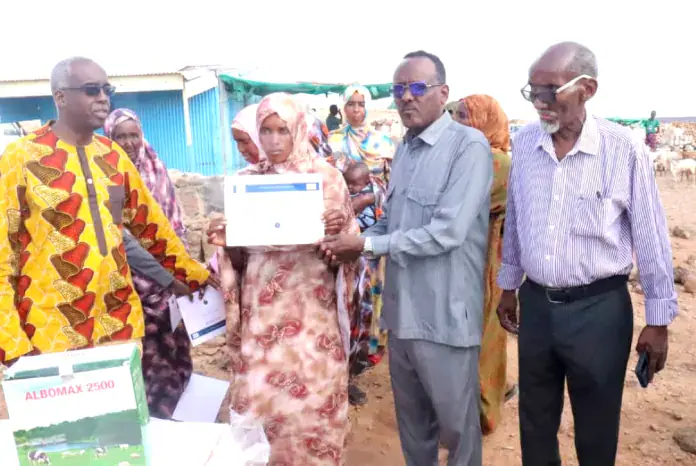
The Djibouti Regional Economic Corridor Project (PCERD) is not only upgrading the country's infrastructure but also supporting local communities affected by the new road construction. In Jaban As, a rural area about 30 kilometers from the capital, the project is helping women's dairy cooperatives to improve their livelihoods. The project, funded by the World Bank through the International Development Association (IDA), aims to rehabilitate the most degraded sections of the Djibouti-Ethiopia road axis.
The PCERD has a social component that aims to mitigate the impact of the road construction on local populations. In Jaban As, the project is supporting the creation of a dairy cooperative comprising 16 households. The goal is to transform a traditional activity into a more organized sector that can provide regular income to families. The Agence Djiboutienne de Développement Social (ADDS) has provided training on cooperative management to 16 women, enabling them to acquire the necessary skills to organize and manage their collective activity.
The dairy sector in Jaban As faces several challenges, including the health of the livestock. Recently, the area has experienced significant rainfall, attracting many herders from neighboring regions and countries. This has led to the spread of animal diseases. To address this issue, the project has organized a vaccination campaign for the livestock in the sector. The campaign, which lasted for three days, aimed to protect the animals and prevent the spread of diseases.
The project has also provided veterinary care and equipment to support the dairy cooperatives. The ADDS has distributed veterinary medicines and equipment, including 640 bags of maize for animal feed, 4,000 plastic bottles, and 16 pasteurization baths. These supplies will help improve milk production, conservation, and marketing, while promoting better valorization of milk from family farms.
According to Abdoulatif Mohamed, head of the project at ADDS, the goal is to create a cooperative that can improve the income-generating activities of women by valorizing the resources they have. The project aims to support the women in transforming their traditional activity into a more organized sector that can provide regular income. Loula Amir Ragueh, one of the women beneficiaries, said that before the project, they only sold milk individually, but now they will be able to improve their production and earnings through the cooperative.
The PCERD is a strategic project that aims to rehabilitate the most degraded sections of the Djibouti-Ethiopia road axis. The project, implemented by the Agence Djiboutienne des Routes (ADR), will not only improve the road infrastructure but also support local communities affected by the construction. The project's social component is crucial in mitigating the impact of the road construction on local populations and supporting their livelihoods.
The project has brought together various stakeholders, including government officials, representatives from the ADDS, ADR, and veterinary services. The event, which took place recently, was attended by the Prefect of Arta, Hassan Dabaleh Ahmed, and the President of the Regional Council, Elmi Bouh Goudadeh. The project's impact is expected to be significant, improving the livelihoods of local communities and supporting the development of the dairy sector in Jaban As.
Key points
- The Djibouti Regional Economic Corridor Project (PCERD) is supporting women's dairy cooperatives in Jaban As, providing training, veterinary care, and equipment to improve their livelihoods.