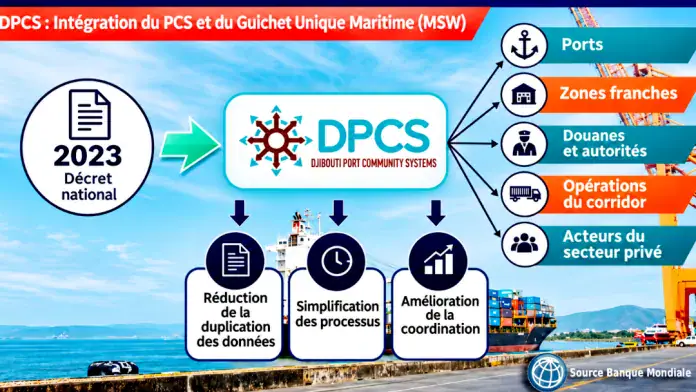
The World Bank has recognized Djibouti's experience in implementing the Djibouti Port Community System (DPCS) as part of its new international online training program on digital transformation of ports. The program, titled "Digital Transformation of Ports for Trade Facilitation and Port Optimization," aims to show how port community systems contribute to modernizing logistics chains, simplifying administrative formalities, and enhancing port competitiveness. DPCS is one of the international case studies selected by the World Bank.
The DPCS has been presented as a model of successful digitalization and regional logistics integration. Djibouti's port community system brings together the functionalities of a port community system and a maritime single window, facilitating the sharing of information and coordination of operations among various stakeholders, including port authorities, customs services, terminal operators, shipping companies, freight forwarders, free zones, and carriers. This approach has reduced administrative fragmentation, repetitive data entry, and accelerated the processing of customs formalities.
The World Bank's program was developed with the support of the Korea-World Bank Partnership Facility, in collaboration with several international institutions, including the International Maritime Organization, the International Association of Ports and Harbors, and the Busan Port Authority. The program is designed for an international audience of port authorities, public decision-makers, and transport and logistics professionals. It relies on concrete experiences to demonstrate how port community systems can modernize logistics chains and enhance port competitiveness.
Djibouti's strategic location on one of the main trade routes in the Horn of Africa makes its port performance crucial for regional trade. The country handles over 95% of Ethiopia's foreign trade, making the efficiency of its port infrastructure and logistics critical for regional exchanges. DPCS plays a central role in modernizing processes by integrating the functionalities of a port community system and a maritime single window.
The implementation of DPCS has yielded significant operational results, including a reduction in response time to quay allocation requests from 72 hours to just one hour. Similarly, the time required for freight forwarders to process certain port documentary formalities has been reduced from eight hours to an average of 45 minutes. These improvements illustrate the impact of digitalization on the efficiency of procedures, reduction of administrative delays, and enhancement of logistics operation predictability.
The World Bank's case study also highlights Djibouti's experience in enhancing cross-border connectivity. By improving visibility on goods movements and sharing information between different segments of the Djibouti-Ethiopia corridor, DPCS contributes to better coordination of trade flows and more integrated management of transport operations. The experience also underscores the importance of data sharing and coordination among stakeholders in the logistics chain.
The DPCS is evolving towards a new generation of digital services, leveraging artificial intelligence and historical logistics data analysis to develop anticipation and decision-making capabilities. The objective is to enable port and logistics actors to better forecast goods movements, anticipate operational needs, and optimize activity planning. This evolution reflects a broader ambition to make data a genuine performance lever for more intelligent, reactive, and coordinated logistics.
Key points
- The World Bank has recognized Djibouti's DPCS as a successful model of digitalization and regional logistics integration.
- The DPCS has reduced response time to quay allocation requests from 72 hours to just one hour.
- The DPCS is evolving towards a new generation of digital services, leveraging artificial intelligence and historical logistics data analysis.