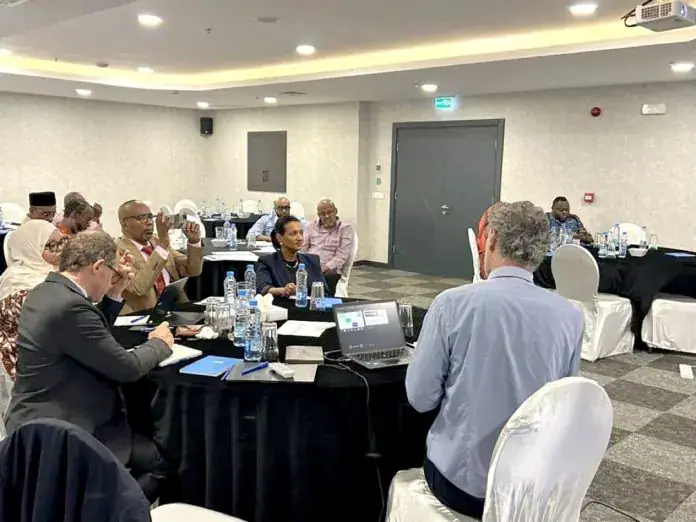
The government of Djibouti has initiated a reform process aimed at strengthening the independence of its National Human Rights Commission (CNDH) and ensuring its conformity with the Paris Principles. This move comes after a two-day consultation workshop that concluded on Thursday, where stakeholders, including parliamentarians, CNDH officials, international partners, and civil society representatives, discussed necessary legislative changes. The reform seeks to consolidate the commission's independence, guarantee its financial autonomy, and enhance its investigative powers.
The consultation, held at the Best Western Hotel, involved an examination of the legal framework governing the CNDH, with a focus on aligning it with international standards for national human rights institutions. Key areas of discussion included institutional guarantees for an autonomous commission, functional independence, financial resources, transparent member selection, expanded prerogatives, and strengthened investigative capabilities. The workshop was organized by the CNDH in collaboration with the National Assembly and supported by a technical assistance project funded by the European Union.
The reform is considered crucial for Djibouti, especially following its acceptance of several recommendations during the fourth cycle of the Universal Periodic Review (EPU), which emphasized the need for a more independent and effective CNDH. According to Patrick Dupont, first counselor at the European Union delegation in Djibouti, the EPU serves not only as an international follow-up exercise but also as a tool to support national reforms. He welcomed the collaborative effort between the CNDH and the National Assembly.
Ali Soubaneh Atteyeh, president of the CNDH, highlighted the significance of the reform, emphasizing that revising the commission's founding law is essential for adapting its operations to the Paris Principles and evolving international mechanisms for human rights promotion and protection. He appreciated the involvement of parliamentarians and the support of partners, including the UN Population Fund (FNUAP), which has a new resident representative in Djibouti, Amina Abdoulkader Mohamed, appointed in August 2026.
Kaltoun Farah Saïd, president of the National Assembly's law, legislation, and human rights commission, underscored the institutional importance of the CNDH in Djibouti's national architecture for promoting and protecting fundamental rights. She stressed the need for a clear mandate, guarantees for exercising that mandate, and enhanced competencies and investigative powers for the commission, along with administrative and financial autonomy.
An outcome of the two-day workshop is the agreement to extend the collaboration beyond the event. Participants welcomed the prospect of establishing a joint commission to continue the work, deepen proposals, and accompany the revision process of the CNDH's founding text. They also discussed the need for a concerted roadmap to organize the next steps of this reform.
The reform process aims to enable the CNDH to fully exercise its mandate, receive complaints, conduct investigations, document alleged human rights abuses, and formulate recommendations with concrete effects on concerned institutions. The initiative is seen as pivotal to the credibility and effectiveness of Djibouti's human rights framework.
Key points
- The reform of Djibouti's National Human Rights Commission aims to enhance its independence, autonomy, and alignment with international Paris Principles.