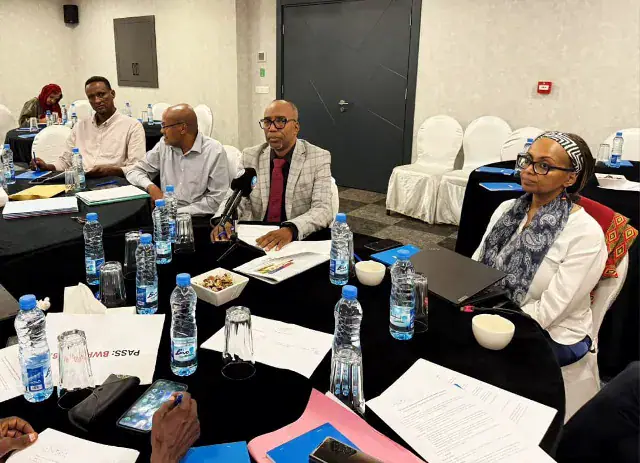
A two-day workshop aimed at reviewing the legal framework of Djibouti's National Human Rights Committee has concluded in Djibouti City. The event, which took place at the Best Western Premier Hotel, brought together various stakeholders, including the Committee's chairman, its secretary-general, members of the National Assembly, representatives from the European Union, the United Nations Population Fund, and several government ministries and civil society organizations. The workshop focused on discussing and exchanging ideas on how to develop the legislative system governing the Committee's operations and enhance its institutional, administrative, and financial independence.
The consultations are part of efforts to update the Committee's legal and institutional framework, with a focus on exploring legislative reforms that align national laws with the Paris Principles. These principles serve as an international benchmark for determining the independence, pluralism, and effectiveness of national human rights institutions. The Committee's chairman emphasized the importance of this legislative review in consolidating the institution's independence and developing its operational capacities, enabling it to carry out its tasks and responsibilities in line with international standards.
The European Union representative highlighted the crucial role played by the National Assembly in developing the national legislative system, ensuring its consistency with Djibouti's international commitments and strengthening the legal framework for protecting human rights. The Chair of the Parliament's Human Rights Committee stressed that promoting and protecting human rights are fundamental pillars for establishing the rule of law, justice, and social cohesion. She also underscored the need for a robust legislative framework that provides the National Human Rights Committee with the necessary powers and resources to carry out its tasks effectively and independently.
The workshop discussions covered several key areas related to enhancing the Committee's performance and institutional effectiveness, including consolidating its independence, reviewing the mechanisms for appointing its members, and entrenching its administrative and financial autonomy. Participants also explored ways to develop the Committee's human resources, expand its investigative powers, and improve its complaint-handling and reporting procedures.
At the end of the two-day consultation, participants identified the main areas for proposed legislative and institutional reforms, emphasizing the need to continue this participatory process by developing a clear roadmap that outlines the practical steps required to implement the agreed-upon recommendations. This roadmap is expected to guide the implementation of the reforms and ensure the Committee's enhanced independence and effectiveness.
The National Human Rights Committee's review process is supported by various partners, including the European Union and the United Nations Population Fund. These organizations recognize the importance of a robust and independent national human rights institution in promoting and protecting human rights in Djibouti. The Committee's strengthened independence and effectiveness are seen as critical factors in advancing human rights and promoting social justice in the country.
The conclusion of the workshop marks an important step towards enhancing the National Human Rights Committee's role in promoting and protecting human rights in Djibouti. The agreed-upon recommendations are expected to inform future reforms aimed at strengthening the Committee's institutional and operational capacities, ultimately contributing to a more robust and effective human rights framework in the country.
Key points
- The workshop aimed to review and enhance the legal framework of Djibouti's National Human Rights Committee.
- The Committee's independence and effectiveness are seen as critical factors in advancing human rights and promoting social justice in Djibouti.
- A clear roadmap is expected to guide the implementation of the agreed-upon recommendations.
Reporting sources
- Al Qarn · Al Qarn