Djibouti is enhancing its response to climate change by restructuring and operationalizing its national and regional governance structures. The country has long been addressing the impacts of climate change, which manifest differently across various regions. To better coordinate climate action, the government has decided to reform its Committee national directeur sur les changements climatiques (CNDCC) and establish Comités régionaux sur les changements climatiques (CRCC).
The restructuring efforts, supported by the United Nations Development Programme (PNUD), aim to create a more effective governance framework. This framework will enable better coordination of public policies, orientation of investments, and inclusion of regional realities in national decision-making. The CNDCC, established in 1999, will be revitalized with a clearer mandate and strengthened functionality.
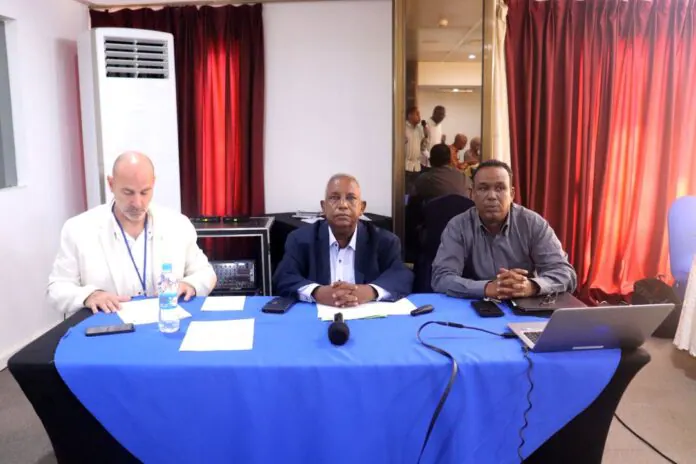
A workshop was held at the Sheraton Hotel, bringing together institutional actors, regional and civil society representatives. They examined and validated the results of a support mission aimed at restructuring the CNDCC and establishing CRCCs. The new architecture seeks to bring national decisions closer to local realities. The workshop was attended by high-ranking officials, including the Secretary General of the Ministry of Environment and Sustainable Development, Dini Abdallah Omar.
The new model for the CNDCC includes a strategic body, an executive body, technical committees on adaptation and mitigation, and a permanent secretariat. The CNDCC's primary mission will be to guide national climate action, strengthen coordination among sectors, and oversee the implementation of climate-related strategies and projects. The creation of five regional committees in Obock, Tadjourah, Ali-Sabieh, Dikhil, and Arta will ensure that regional realities are represented.
These regional committees will serve as relays between the territories and the national level, bringing together local authorities, deconcentrated services, territorial collectivities, and civil society representatives. Their role will be to identify region-specific vulnerabilities, define adaptation priorities, coordinate interventions, and relay needs and projects to the CNDCC. This reform aims to integrate local realities into national decision-making.
The PNUD's Resident Representative in Djibouti, Philippe Clerc, emphasized the need for solid institutions with clearly defined responsibilities and effective coordination. This will enable the integration of local realities into national decisions. The project to integrate climate change adaptation into planning and budgeting processes in Djibouti is being implemented by the Ministry of Environment and Sustainable Development with PNUD support and Green Climate Fund financing.
The next steps will involve finalizing the legal framework, designating CNDCC and CRCC members, establishing a secretariat, training sector actors, and applying operating procedures. The goal is to move from institutional conception to concrete implementation. The revised nationally determined contribution of 2025 provides a reference framework for these efforts, which are crucial for effective climate action in Djibouti.
Key points
- Djibouti establishes new national and regional climate change committees to enhance governance and coordination.