The Anglophone crisis in Cameroon, which began in 2016, has led to a significant displacement of people, with the United Nations High Commissioner for Refugees estimating that between 2.1 and 2.2 million people have been affected by the violence and insecurity. The conflict started as a protest by teachers and lawyers over the perceived marginalization of English-language education and common-law systems, which they say favored French. This escalated into wider demonstrations and a government crackdown, eventually leading to armed conflict between government forces and separatist groups.
For children displaced by the conflict, reaching safety has not ended the struggle. In Buea, the capital of Cameroon's Southwest region, some children are balancing school with market trading to help their families survive. An 11-year-old boy named Lorane, who fled his home in the conflict-affected Southwest Region with his family, says that while they are safer in Buea, they still face significant challenges. "At least here in Buea, there are no gunshots, and we do not have to hide in the bush," he says, describing the relative safety his family found.
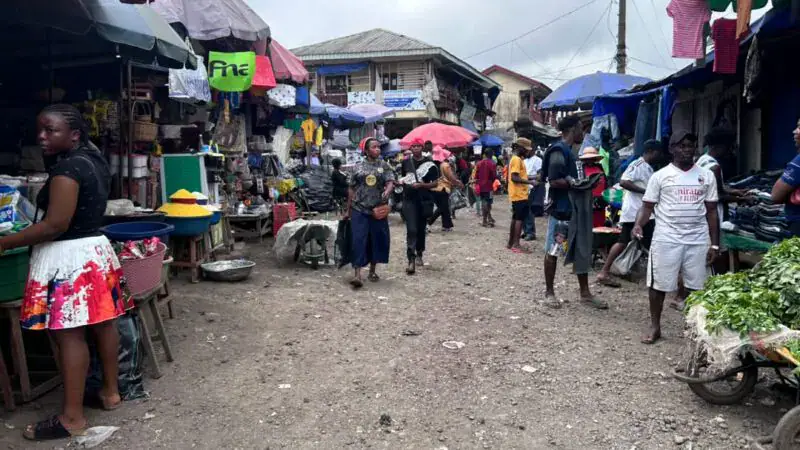
However, leaving their communities also meant losing homes, familiar surroundings, friendships, and, for some, years of education. In Buea, the struggle to rebuild family livelihoods has introduced another responsibility to their lives: helping their parents earn a living. Many children from displaced families sell goods at Buea's OIC Market, particularly during weekends and before school. Some travel from neighboring communities to help their parents sell goods, while others work around family-owned stalls.
A 14-year-old girl named Joy has been working since her family fled their village when she was in Class Five. She travels from Mutengene to Buea on weekends to sell sachets of bleach, which her mother buys in bulk and repackages into smaller sachets. Joy says daily sales can reach CFA 10,000–15,000, helping support the household and her siblings. Her work allows her to contribute to the family while continuing her education.
However, not all displaced children have been as fortunate as Joy. A 14-year-old girl named Sidoine lost four years of schooling due to the conflict. Her family fled Ekona after their house was burned while they were away at the farm. She remembers hiding in the bushes when they heard attacks were coming, unsure what would happen next. Sidoine's experience is not unique, as over 223,700 children have dropped out of school in Cameroon's Northwest and Southwest regions.
The impact of the conflict on education has been severe, with 2,463 schools non-operational in the affected regions. This has left many children without access to education, forcing them to find alternative ways to support their families. The situation has also led to a significant increase in child labor, as children are forced to work to help their families survive. This can have long-term consequences for their education and future prospects.
Efforts are being made to support displaced children and their families, but more needs to be done to address the root causes of the conflict and its impact on education. The Cameroonian government, along with international organizations, must work together to find a lasting solution to the crisis and ensure that children can access education and rebuild their lives.
Key points
- Over 223,700 children have dropped out of school in Cameroon's Northwest and Southwest regions.
- 2,463 schools are non-operational in the affected regions.
- The conflict has led to a significant increase in child labor, as children are forced to work to help their families survive.
Reporting sources
- Growing up displaced in Cameroon after ten years of conflict · Global Voices Africa