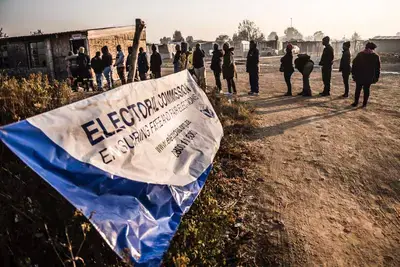
On May 29, 2024, 16.29 million South Africans cast their ballots, marking the lowest voter turnout since 1994 at 58.64% of the 27.78 million registered voters. This translates to approximately 41% of the voting-age population participating in the electoral process. The number of eligible adults who never registered has grown significantly, from around 7 million in 2014 to about 11 million today. Estimates of the voting-age population range from 39.7 million to 41.4 million.
The low voter turnout has sparked concerns about the effectiveness of the electoral system in addressing the needs of South African citizens. Official unemployment stands at 33.6%, with a staggering 47.4% among young people. When including those who have given up looking for work, the figure rises to 43.8%. South Africa is also ranked first among 164 countries for inequality by the World Bank. These statistics have led many to question the impact of voting on the lives of ordinary people.
The African National Congress (ANC), still the largest party, won 6.46 million votes in the 2024 election, which is roughly one in six eligible adults. Those who stayed away from the polls outnumbered ANC voters by more than three to one. Local government elections have seen even lower turnouts, with 45.79% of registered voters participating in 2021, and fewer than 30% of those eligible. The IEC has acknowledged that logistical issues, such as new voting-station rules, contributed to low turnout.
Many South Africans who do not vote are not expressing indifference but rather a verdict on the effectiveness of the electoral system. They often cite that politicians only engage with them during election periods and then disappear afterwards. This sentiment aligns with anarchist principles, which argue that the state is not a neutral machine but an institution that concentrates power and protects property. Anarchists also contend that real power lies in what people build themselves, outside of and against the state.
The anarchist tradition in South Africa has a rich history, with examples of workers and communities organizing and building counter-power independent of parties and the state. In 1917, African workers in Johannesburg formed the Industrial Workers of Africa, and in 1973, close to 100,000 workers went on strike in Durban without a union or a vote. More recently, the Treatment Action Campaign, the Anti-Privatisation Forum, and the Soweto Electricity Crisis Committee have all achieved significant gains through collective action.
However, abstention from voting is not considered a form of resistance by the anarchist tradition. Silence is not a strategy, and a boycott that ends with disengagement costs the powerful nothing. Instead, anarchists advocate for organizing and building counter-power in communities and workplaces. This approach has led to significant gains for workers and poor communities in South Africa, often forcing governments to concede to their demands.
The upcoming municipal elections will take place against a backdrop of significant challenges, including broke and captured municipalities, and a collapse of basic services such as sewage and water supply. The debate on anarchism and voter turnout highlights the need for South Africans to re-examine their relationship with the electoral system and consider alternative forms of organizing and collective action.
Key points
- Low voter turnout in South Africa sparks discussion on anarchism and abstention as a form of protest or disengagement.
- Anarchist tradition in South Africa advocates for organizing and building counter-power independent of parties and the state.
- Abstention from voting is not considered a form of resistance by the anarchist tradition, which instead advocates for collective action and organizing.