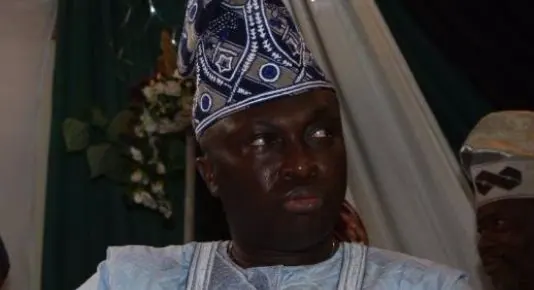
Dipo Dina, a trained accountant and businessman from Ijebu Ode, had been an active participant in Ogun State's politics since the Fourth Republic. He contested for the Ijebu Central Federal Constituency seat in 2003 under the Alliance for Democracy. By the mid-2000s, his political ambitions had grown, leading to the formation of the Dipo Dina Movement. This organisation became synonymous with its vocal criticism of Governor Otunba Olugbenga Daniel's administration.
In the April 14, 2007, Ogun State gubernatorial election, Dina polled 79,915 votes, a distant third behind Senator Ibikunle Amosun of the All Nigeria Peoples Party and incumbent Otunba Olugbenga Daniel, who secured 426,132 votes. Dina rejected the results, alleging widespread rigging, violence, and other irregularities. He filed a petition with the Ogun State Election Petition Tribunal to challenge Governor Daniel's victory.
Dina's legal team, led by Prince Babajide Aladejobi, initially prepared to call 123 witnesses, eventually scaling it down to 32 during the pre-trial phase. Despite his efforts, a substantial part of his petition was struck out, and he ultimately lost at the tribunal. Undeterred, Dina escalated his challenge to the Court of Appeal, the highest court for governorship election petitions at the time.
The Court of Appeal in Ibadan, Oyo State, upheld Daniel's election in 2010. Dina lost this final legal avenue, leaving Daniel's victory officially unchallenged. This outcome became a critical, though often overlooked, detail in the narrative of his political life. Dina's determination to challenge perceived corruption was evident during his 2005 Christmas in police custody, where he vowed to remain "unbowed."
The loss in court didn't silence Dina; he continued to be an outspoken critic of Daniel's administration in Ogun State, maintaining his political visibility and leveraging the Dipo Dina Movement. Before the 2007 election, this criticism had even led to legal troubles for Dina. He was arrested and detained in 2006 for allegedly possessing stolen government documents, a case that the Ogun State Government formally withdrew years after his death in April 2016.
The political friction between Dina and Daniel escalated to the point where the state government obtained an injunction restraining the Dipo Dina Movement and a national newspaper from publishing material related to state finances. Dina's murder on January 25, 2010, in Ota, Ogun State, cut short a career marked by persistent activism and ambition. His party, the Action Congress, quickly pointed to political undertones, given his extensive history of political battles.
The circumstances surrounding his death remain unresolved, with no one brought to justice as of January 2015. Dina's unyielding challenge of the 2007 election results, and his subsequent refusal to retreat from Ogun State politics, offers a profound insight into the nature of political ambition in Nigeria. His legacy isn't defined by his third-place finish, but by his enduring fight, which continues to resonate in Nigerian political discourse today.
Key points
- Dipo Dina's challenge of the 2007 Ogun State gubernatorial election results led to a protracted legal battle.
- Dina's murder in 2010 remains unresolved.
- His legacy continues to influence Nigerian politics.