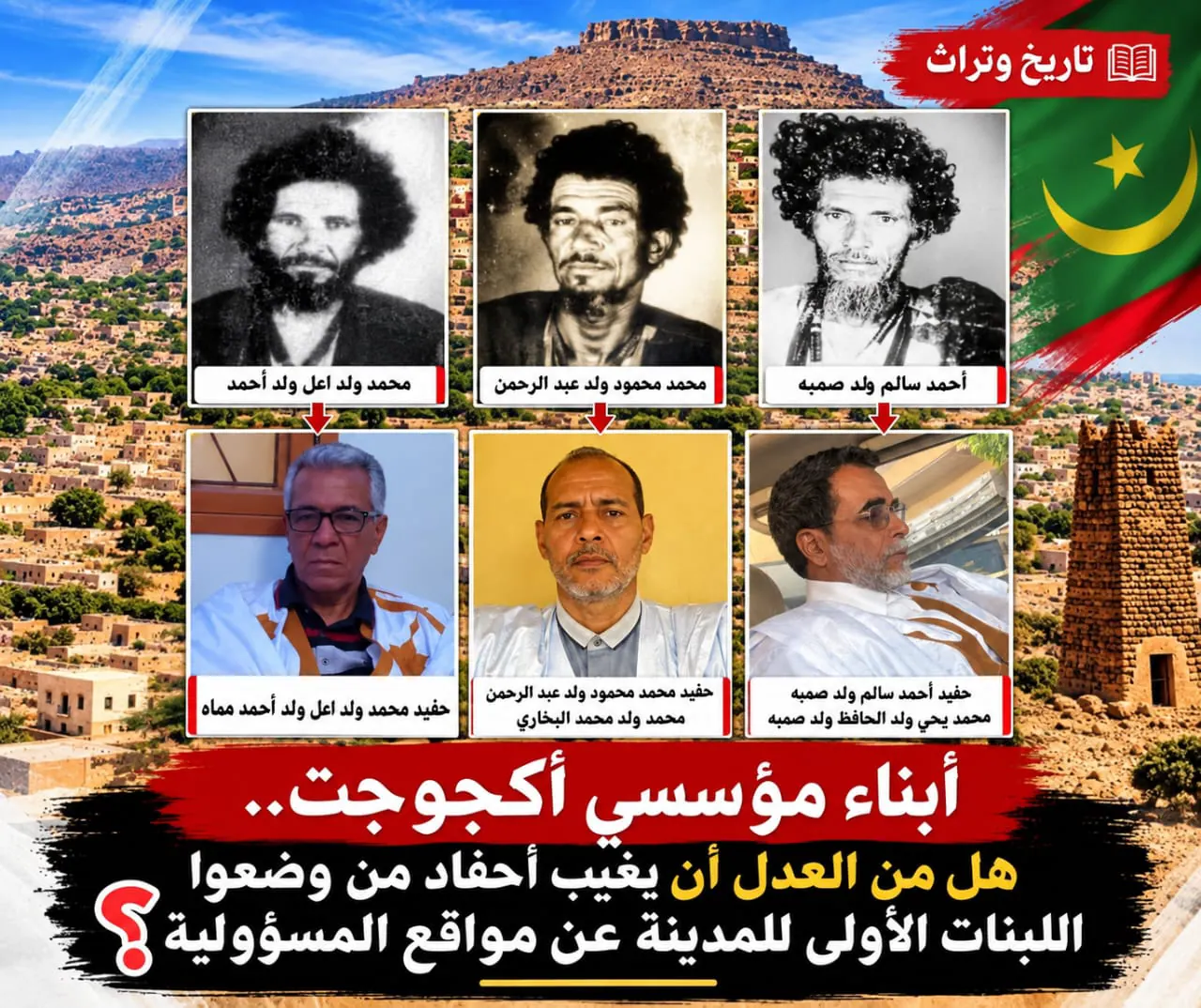
The city of Akjoujt in Mauritania is revisiting its history and the names of men who played a crucial role in its early development. Ahmed Salem Ould Smemb, Mohamed Mahmoud Ould Abdourahmane, and Mohamed Ould Ahel Ould Ahmed are among those remembered as the city's founding fathers in 1937. These individuals were instrumental in shaping the city's early stages, envisioning a community with schools, hospitals, and markets. Their legacy has contributed significantly to Akjoujt's current status.
However, the absence of their descendants in today's local governance is raising eyebrows. Despite their ancestors' pivotal roles, the sons and grandsons of these founding fathers seem to be missing from even the most basic local representation, such as the municipal council. This situation prompts questions about how families so integral to the city's inception are excluded from participating in local leadership, let alone higher responsibility positions.
It is essential to clarify that lineage alone should not be a criterion for assuming responsibilities. Public offices are based on merit, efficiency, and entitlement. Nonetheless, for those descendants who possess the necessary competence, willingness, and eagerness to serve, it is only fair that they have equal opportunities to access leadership roles and compete for top positions, just like all other qualified citizens.
The recognition of these founding fathers' contributions should not be limited to historical records but should also extend to acknowledging their families' heritage. By doing so, their descendants can actively participate in Akjoujt's present and future. Given that the city remembers its founders, it seems only fair that their descendants, if qualified, should have a place in leadership that matches their heritage.
The situation in Akjoujt brings to the forefront discussions about presence, fairness, and entitlement. While it is crucial to honor the past, it is equally important to evaluate and reward competence and grant responsibility to those who are entitled. The narrative is not about granting privileges based on lineage but ensuring that those with the potential to contribute are given the opportunity.
The broader question arises when considering the absence of these descendants from higher leadership positions. If they are not represented even in advisory roles, it becomes necessary to pose the question on a larger scale: where are they in the hierarchy of responsibility? This situation calls for an examination of how opportunities for participation and leadership are distributed.
Ultimately, the focus should be on creating a fair and merit-based system where everyone, regardless of their background, has the chance to contribute to their community. By recognizing the past and working towards a more inclusive future, Akjoujt can ensure that its history and heritage are preserved while paving the way for new generations of leaders.
Key points
- The absence of descendants from Mauritania's founding fathers in leadership roles raises questions about fairness and recognition of their heritage.