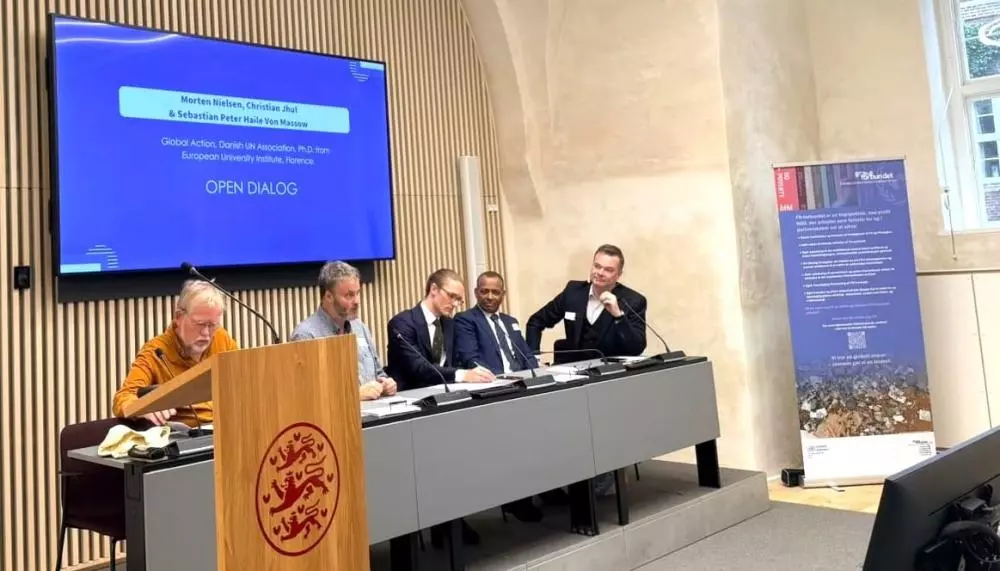
The Danish Parliament in Copenhagen recently hosted a Nordic symposium on Western Sahara, organized by the Danish United Nations Association. The event brought together representatives from Denmark, Sweden, and Norway, as well as a Sahrawi delegation led by Sidi Mohamed Amar, a member of the National Secretariat and representative of the Polisario Front to the United Nations. The symposium aimed to shed light on the ongoing occupation of Western Sahara by Morocco.
In his opening speech, Finn Riska Nielsen, president of the Danish United Nations Association, emphasized that the Western Sahara issue remains one of the last decolonization questions that has not been resolved. He highlighted the significant role the United Nations has played in decolonization worldwide and stressed the need for a lasting solution based on the Sahrawi people's right to self-determination. Nielsen also referenced the advisory opinion of the International Court of Justice, which disputed Moroccan claims of sovereignty over the territory.
Trina Bertro Mach, a Danish parliamentarian from the Red-Green Alliance party, denounced the continued Moroccan occupation of Western Sahara and called for support for the Sahrawi people and the Polisario Front in their struggle for self-determination. She also criticized the double standards in international politics and reaffirmed her party's commitment to ensuring that the Danish government respects international law regarding Western Sahara.
General Kurt Mosgaard, former commander of the United Nations Mission for the Referendum in Western Sahara (MINURSO), provided an overview of the region's history and the role of MINURSO, which was established to organize a free and fair referendum to determine the fate of Western Sahara. Mosgaard emphasized that a future Sahrawi state would be rich in natural resources but noted that Morocco, with the complicity of foreign parties, including the European Union, is exploiting the region's resources.
Astrid Schildkard Pedersen, a professor of international law at the University of Copenhagen, discussed the right to self-determination as enshrined in the UN Charter and relevant resolutions. She referenced the International Court of Justice's advisory opinion on Western Sahara, which refuted Moroccan claims of sovereignty, and stressed that UN member states have a duty to respect the Sahrawi people's right to self-determination.
Mogens Lykketoft, former Danish foreign minister, addressed the challenges facing the implementation of international law due to the actions of "predatory" parties. He cited the denial of self-determination to the Palestinian and Sahrawi peoples by Israeli and Moroccan colonial powers, respectively, and called for a fair and lasting solution that allows the Sahrawi people to determine their future freely.
Erik Hagen, representative of the Norwegian Committee for Western Sahara, emphasized the need for increased efforts in Scandinavian countries to end Moroccan occupation policies in Western Sahara, which include the systematic plundering of Sahrawi resources with the complicity of foreign parties, including the European Union. He also criticized the European Commission's attempts to circumvent EU Court of Justice rulings on Western Sahara.
Key points
- The Danish Parliament hosted a Nordic symposium on Western Sahara to highlight the region's struggle for self-determination under Moroccan occupation.
- The symposium brought together representatives from Denmark, Sweden, and Norway, as well as a Sahrawi delegation, to discuss the ongoing occupation and potential solutions.
- Speakers at the symposium emphasized the need for a lasting solution based on the Sahrawi people's right to self-determination and the importance of respecting international law.