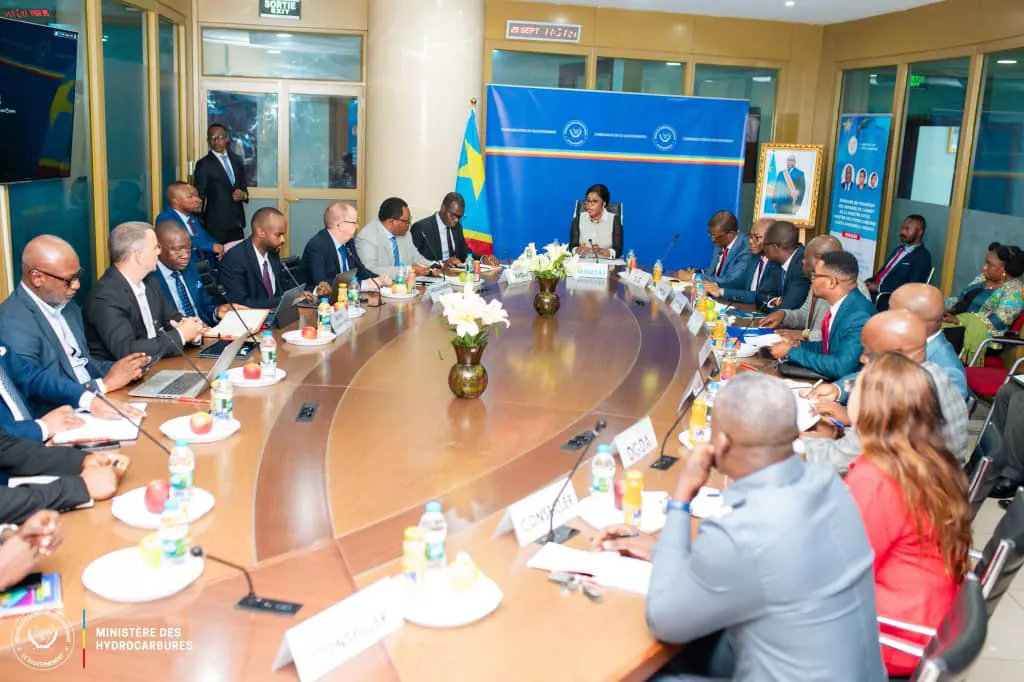
The Democratic Republic of Congo's government has taken a major step in its efforts to curb oil fraud and recover millions of dollars lost through smuggling. Under the leadership of Minister of State for Hydrocarbons Acacia Bandubola Mbongo, an inter-ministerial and customs task force has validated the imminent launch of a pilot project combining software intelligence and physical controls. The project aims to neutralize smuggling networks that have long deprived the public treasury of vital resources.
The pilot project will be deployed on highly strategic and porous corridors in the East and South, which have been identified as critical areas for smuggling. The system combines the SIGOIL software, a sovereign governance platform developed with Swiss Authentis, and physical controls by Intertek. The SIGOIL platform centralizes all downstream sector data in real-time, allowing the Ministry of Hydrocarbons to track and monitor oil flows. This technological innovation marks a major turning point in the governance of the country's energy resources.
The SIGOIL system is designed to provide real-time data on oil flows, enabling the government to track and monitor the movement of oil and identify potential cases of fraud. According to Guillaume Chaize, Director General of Swiss Authentis, the system is ready for deployment and will enable the Ministry of Hydrocarbons to effectively combat fraud. The use of this technology is expected to bring transparency and accountability to the oil sector, which has long been plagued by corruption and smuggling.
The targeting of the South and East corridors is not coincidental, as these routes have been identified as critical areas for smuggling. The corridors, which are fed by Tanzania, Zambia, Zimbabwe, and South Africa, concentrate a significant share of the country's oil fraud. To address this issue, Intertek will deploy intelligent electronic seals (GPS/GSM) on tanker trucks from the countries of origin. This will enable the government to track the movement of oil and identify potential cases of fraud.
The use of electronic seals and real-time data will enable the government to replace human controls with algorithmic infallibility. By cross-referencing the geographical position of tanker trucks and the conformity of tax declarations, the government will be able to identify and prevent cases of fraud. This hybrid system is expected to provide a significant boost to the government's efforts to curb oil fraud and recover millions of dollars lost through smuggling.
The success of the pilot project will depend on the government's willingness to apply sanctions and the ability of the security apparatus to impose controls in the provinces of the East. The use of technology is seen as a critical component in the fight against corruption, which can no longer be won solely through decrees. The government will need to demonstrate its commitment to enforcing the new system and imposing penalties on those found to be engaging in smuggling and fraud.
The launch of the pilot project marks a significant step towards a new paradigm of economic sovereignty for the Democratic Republic of Congo. If successful, the project could provide a model for other countries in the region to follow. The use of technology to combat corruption and smuggling has the potential to bring significant benefits to the country, including increased revenue and improved governance.
Key points
- The Democratic Republic of Congo's government has launched a plan to curb oil fraud and recover millions of dollars lost through smuggling.
- The plan combines software intelligence and physical controls, including the use of electronic seals and real-time data.
- The success of the plan will depend on the government's willingness to apply sanctions and the ability of the security apparatus to impose controls.