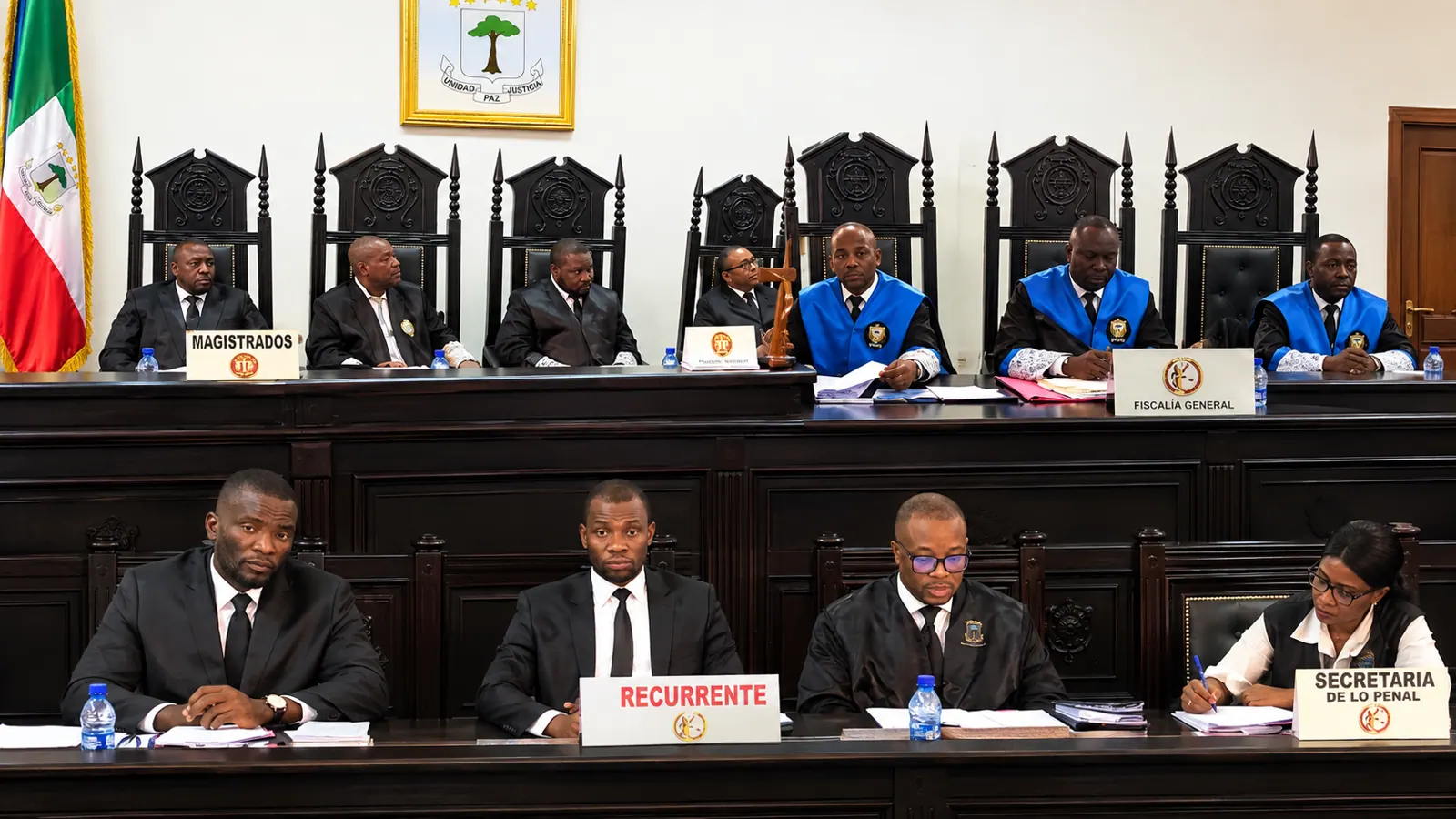
The Court of Appeal in Equatorial Guinea, presided over by Acting President Juan Eliseo Mbomio, has heard arguments from parties involved in the TDT case. The case revolves around the installation of a Digital Terrestrial Television system in the country. The investigation has implicated several individuals, including Maximiliano Martín Meko Abeme, Javier Marañón Montero, David Rodríguez Ballesta, and Sekou Fanamadi, among others. The defendants are accused of various crimes, including bribery, fraud, tax evasion, and embezzlement.
During the hearing, the defense teams requested the court to revoke two rulings made during the investigation phase. The first ruling, Auto de Procesamiento nº 35/2026, formally keeps Maximiliano Martín Meko Abeme in the proceedings. The second ruling, Auto de Conclusión del Sumario nº 35/2026, concludes the investigation phase and advances the case to the next procedural stage. Meko Abeme's defense argued that evidence presented during the investigation could potentially exonerate their client, but this evidence was not adequately considered by the investigating judge.
The defense team representing expatriates Javier Marañón Montero, David Rodríguez Ballesta, and Sekou Fanamadi contested the conclusion of the investigation phase. They claimed that during the period when further investigative actions could still be requested, they were unable to maintain necessary contact with their clients to adequately prepare their defense. This limited their ability to directly understand relevant aspects of the case and prepare a defense strategy.
The prosecution, as the respondent, rejected the defense's arguments and requested the Court of Appeal to uphold the rulings made during the investigation phase. This would allow the proceedings to continue according to established procedural channels. The case investigates alleged crimes related to the TDT project, including the diversion of 10,000 million CFA francs intended for the implementation of the system in the country.
The Court of Appeal emphasized that the contested rulings correspond to a phase prior to a potential trial and do not, by themselves, constitute a pronouncement on the guilt or innocence of the investigated individuals. The court has taken note of the parties' positions and adjourned the case for a resolution. The Court of Appeal's decision will determine whether the contested rulings are upheld or revoked, marking the next step in the judicial processing of the TDT case.
The TDT case has garnered significant attention in Equatorial Guinea due to the high-profile nature of the accused and the substantial funds allegedly diverted. The investigation has implicated multiple individuals and entities, and the proceedings are being closely watched by various stakeholders in the country. The case's progression will likely have implications for the country's governance and accountability.
The Court of Appeal's forthcoming decision is expected to have a significant impact on the case's trajectory. If the rulings are revoked, it could potentially alter the course of the investigation and the defense strategies employed by the accused parties. Conversely, if the rulings are upheld, it would likely lead to the case proceeding to the next stage, potentially culminating in a trial.
Key points
- The Court of Appeal in Equatorial Guinea has heard arguments from the defense teams in the TDT case, who are seeking the reversal of two rulings made during the investigation phase.
- The case investigates alleged crimes related to the installation of a Digital Terrestrial Television system in Equatorial Guinea, including the diversion of substantial funds.
- The Court of Appeal's decision will determine the next step in the judicial processing of the case, potentially impacting the country's governance and accountability.