Today, France marks the 56th anniversary of the passing of General Charles de Gaulle, a founding figure of the French Resistance and the Fifth Republic. This occasion prompts reflection on the intricate relationship between de Gaulle and Habib Bourguiba, two pivotal leaders in their respective nations' histories. Historian Mohamed Ridha Lafif examines their interactions, describing them as a "missed rendezvous of giants." De Gaulle, born in Lille in 1890, was a steadfast believer in French sovereignty, while Bourguiba, born in Monastir in 1901-1903, dedicated his life to Tunisia's liberation.
De Gaulle and Bourguiba shared some commonalities despite their differing backgrounds. Both were products of the Third Republic, with de Gaulle serving in the last government of the Third Republic and Bourguiba graduating from the Paris Institute of Political Studies. Their approaches to politics, however, were distinct. De Gaulle was uncompromising on French sovereignty, while Bourguiba prioritized Tunisia's independence. Until 1958, there were no direct contacts between them, despite Bourguiba's extensive diplomatic efforts in France, the United States, and Tunisia.
The turning point in their relationship came in 1958 when de Gaulle returned to power in France. Bourguiba cautiously observed from a distance, relying on his contacts in Paris, including Mohamed Masmoudi and Hassen Belkhodja. Meanwhile, de Gaulle established the Fifth Republic, and France navigated a complex situation in Tunisia. The two leaders' paths finally crossed in 1961 at Rambouillet, but their talks yielded little, and tensions escalated over the Bizerte crisis in July of that year.
The Bizerte conflict resulted in significant human losses, primarily on the Tunisian side. De Gaulle and Bourguiba exchanged accusations, with de Gaulle dismissing the United Nations as "machinery." Their strained relationship persisted throughout de Gaulle's presidency, with no official visits between them. De Gaulle never visited Tunisia, which he had previously seen in 1943, and Bourguiba did not visit France until 1972, at the invitation of President Georges Pompidou.
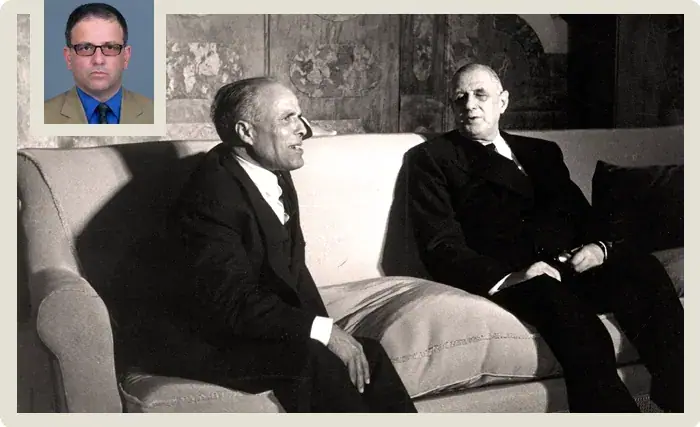
The two leaders finally met briefly at the funeral of President Dwight Eisenhower in Washington on March 30, 1969. Their encounter was captured in a photograph. Despite their limited direct interaction, their governments maintained communication channels through diplomats like Bahi Ladgham and Mohamed Masmoudi. Following de Gaulle's death on November 9, 1970, Bourguiba sent a condolence message, declared a national day of mourning, and ordered a prayer for the deceased at the Zitouna mosque, a rare gesture for a non-Muslim.
Historian Mohamed Ridha Lafif's analysis highlights the complex dynamics between de Gaulle and Bourguiba, two leaders committed to their respective nations' causes. Their interactions, though limited, reflect the broader context of post-colonial politics and international relations during the mid-20th century. As France and Tunisia continue to navigate their historical ties, the legacy of these two leaders remains significant.
The commemoration of de Gaulle's passing serves as a reminder of the enduring impact of his and Bourguiba's leadership on Franco-Tunisian relations. As historians and scholars continue to examine their interactions, new insights emerge into the challenges and opportunities of their time. The "missed rendezvous" between de Gaulle and Bourguiba remains a fascinating chapter in the history of international diplomacy.
Key points
- De Gaulle and Bourguiba's relationship was marked by limited direct interaction, despite their significant influence on their respective nations' histories.
- The Bizerte crisis in 1961 highlighted the tensions between France and Tunisia, with de Gaulle and Bourguiba exchanging accusations.
- Their brief encounter at Eisenhower's funeral in 1969 was a rare moment of direct contact between the two leaders.
Reporting sources
- Bourguiba et de Gaulle: le choc des titans · leaders.com.tn