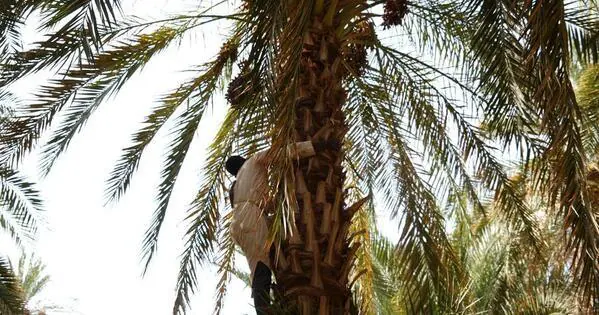
In Al-Baja village, northern Sudan's Al-Dabba locality, 50-year-old Salim Bilal climbs towering palm trees to harvest dates, a trade he has been in for over three decades. The date harvest season, known as "Hash al-Balh," marks the beginning of an economic and social cycle in the region. Bilal's agility is a result of years of experience, and he can harvest over 50 palms a day. His work provides income and employment for his family and others in the village.
According to the Food and Agriculture Organization of the United Nations, Sudan produced around 443,000 tons of dates in 2024 from approximately 37,100 hectares. The date palm provides food, income, and employment for thousands of farmers and families along the Nile. However, the war that started in April 2023 has affected the date palm industry, with production costs rising and farmers' returns decreasing. Farm owner Awad Saleh expects 500 to 600 sacks of dates this season, but rising costs of fuel, electricity, labor, and transportation have reduced farmers' earnings.
The war has led to a significant depreciation of the Sudanese pound, and production costs have continued to rise. Before the war, a 100-kg sack of dates sold for around 25,000 pounds; today, it fetches about 100,000 pounds. However, the higher nominal price has not translated into better returns for farmers. Production has also fallen, with farmers saying a feddan could yield up to 100 sacks before the war, compared to roughly 50 sacks today.
The conflict has redrawn the trade map, with farmers becoming more dependent on local markets due to road closures and fighting. Transportation costs have soared, and the movement of workers has been disrupted. Despite these challenges, the date palm has become an essential source of income for some families, as other livelihoods have declined or been disrupted. In Al-Baja, the harvest season brings the village back to life and restores a sense of normalcy.
For Salim Bilal, the date palm harvest is not just about the yield; it's also about carrying on a family tradition. He is now working alongside his two sons, who are also palm climbers. The harvest season brings a sense of continuity and hope for the future. As the sun sets, Bilal and his sons work together, sorting and packing the freshly cut bunches of dates.
Farm owners like Awad Saleh are struggling to make ends meet due to rising production costs and reduced earnings. Saleh said that the farm's expected output will not cover all the costs of the season. The situation is a challenge for many farmers in the region, who are trying to maintain their livelihoods despite the war.
Despite the challenges, the date palm harvest season in Al-Baja village continues to bring life and hope to the community. The tradition of date palm climbing is being carried on by Salim Bilal and his sons, ensuring that the family's livelihood is sustained. The harvest season is a vital part of the region's economy and social cycle, and its continuation is a testament to the resilience of the people.
Key points
- The date palm harvest season in Sudan's Al-Baja village provides income and employment for thousands of farmers and families along the Nile.
- The war in Sudan has affected the date palm industry, with production costs rising and farmers' returns decreasing.
- Despite challenges, the date palm harvest season continues to bring life and hope to the community in Al-Baja village.