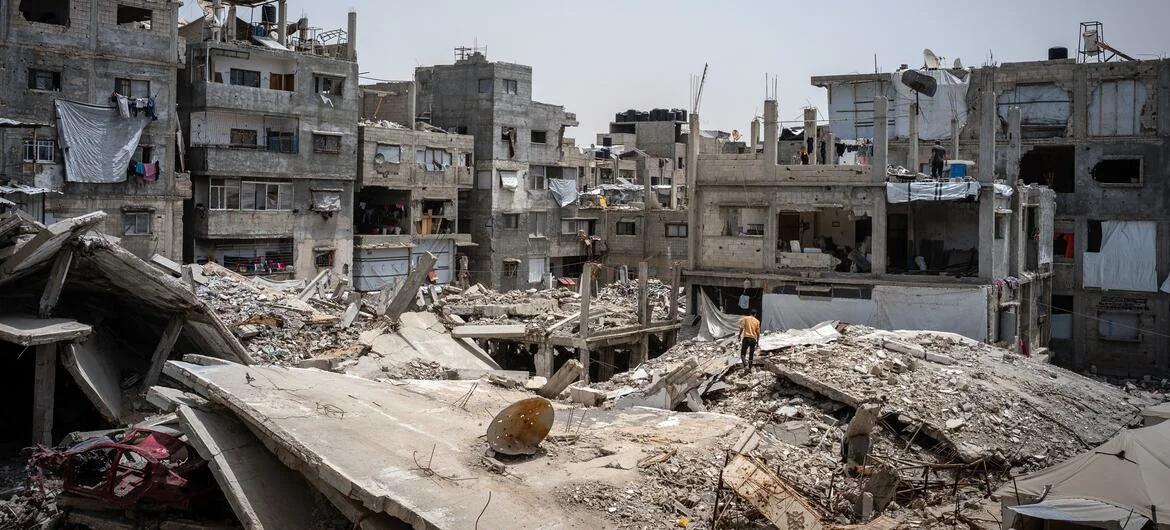
A recent report by the Danish Refugee Council (DRC) highlights the deteriorating situation for approximately 1.8 million displaced Palestinians in Gaza, which accounts for about 86 percent of the territory's population. The study, based on group discussions with 195 internally displaced persons across five Gaza governorates, reveals severe shortages of water, sanitation, and health services. These findings come almost three years after the October 7 war and a year after the October 10 cease-fire plan.
The DRC report accuses Israel of pursuing a "policy of protracted displacement," citing the Israeli-controlled "Yellow Line," a demarcation near the eastern border that is moving westward. This line now confines families to about 30 percent of Gaza's land area. Other actors, including the United Nations and the Israeli government, have also noted the line's shift, though figures differ. Israeli Prime Minister Benjamin Netanyahu recently stated that the line covers 60 percent of Gaza, with plans to expand it further.
The proximity to the Yellow Line hampers humanitarian access, with several kilometers of the zone deemed unsafe or restricted. This limits the delivery of essential supplies to nearby camps. Aid agencies report that camp conditions are dire, with 80 percent of respondents citing water shortages for drinking and washing. Many rely on outdoor cesspits, and shared latrines raise concerns about gender-based violence.
Sanitation problems in the camps have led to rodent infestations, while limited cooking infrastructure and food scarcity increase the risk of burns and malnutrition. Health services are strained, with only half of hospitals and just over a third of primary health centers still functional. Outbreaks, such as over 4,000 chickenpox cases in Khan Younis camps in July, illustrate the rapid spread of disease.
The DRC notes that only 36 percent of displacement sites have a designated manager, typically a national NGO, to coordinate services and address emergencies like collapsing cesspits or unsafe walkways. This lack of management exacerbates the challenges faced by displaced families. The report emphasizes the need for improved coordination and management to address these issues.
In response to the report's findings, the DRC and the Agricultural Development Association (PARC) have called on all conflict parties, especially Israel as the occupying power, to uphold cease-fire commitments. They urge the halt of further expansion of the Yellow Line and the transparent mapping of its route. Additionally, they request the removal of dual-use restrictions on aid and the establishment of a UN monitoring mechanism for cease-fire violations.
The report warns that donor and political attention to Gaza has waned over the past year, even as conditions have not improved. This underscores the need for renewed international engagement to address the humanitarian crisis in Gaza. The DRC's findings highlight the urgent need for action to alleviate the suffering of displaced Palestinians and to work towards a lasting resolution to the conflict.
Key points
- The Danish Refugee Council report details dire conditions for 1.8 million displaced Palestinians in Gaza.
- The Israeli-controlled "Yellow Line" is encroaching on Gaza's territory, confining families to about 30 percent of the land area.
- The report calls for renewed international engagement and action to alleviate the suffering of displaced Palestinians in Gaza.