Nigerian billionaire Aliko Dangote has built a diversified industrial group operating in at least 17 African countries. His conglomerate covers various sectors, including cement, fertiliser, petrochemicals, logistics, ports, energy, and infrastructure. This extensive reach has positioned Dangote as a major player in Africa's industrial landscape. With a focus on large-scale local production, Dangote's cement arm now produces over 55 million tonnes a year from plants in multiple African countries.
Dangote Cement's breakthrough came after 2002 when the group shifted from importing cement to large-scale local production. The Obajana plant, opened in 2007, served as a template for replication across borders. This strategic move enabled Dangote Cement to establish a strong presence in various African markets. The company's cement production facilities are located in Nigeria, Ethiopia, Tanzania, South Africa, Senegal, Zambia, Cameroon, Ghana, Sierra Leone, the Republic of Congo, and Ivory Coast.
Energy analyst Ayodele Oni notes that Dangote targets sectors where governments have failed to deliver, such as Nigeria's dysfunctional refineries. Dangote works closely with policymakers to remove regulatory barriers, facilitating the growth of his business. The Lagos refinery, commissioned in 2022, cost roughly $2.5 billion and generated over $13 billion in revenue in the first half of 2026. This success has prompted a $7 billion expansion plan to triple output and add a fertiliser complex in Ethiopia.
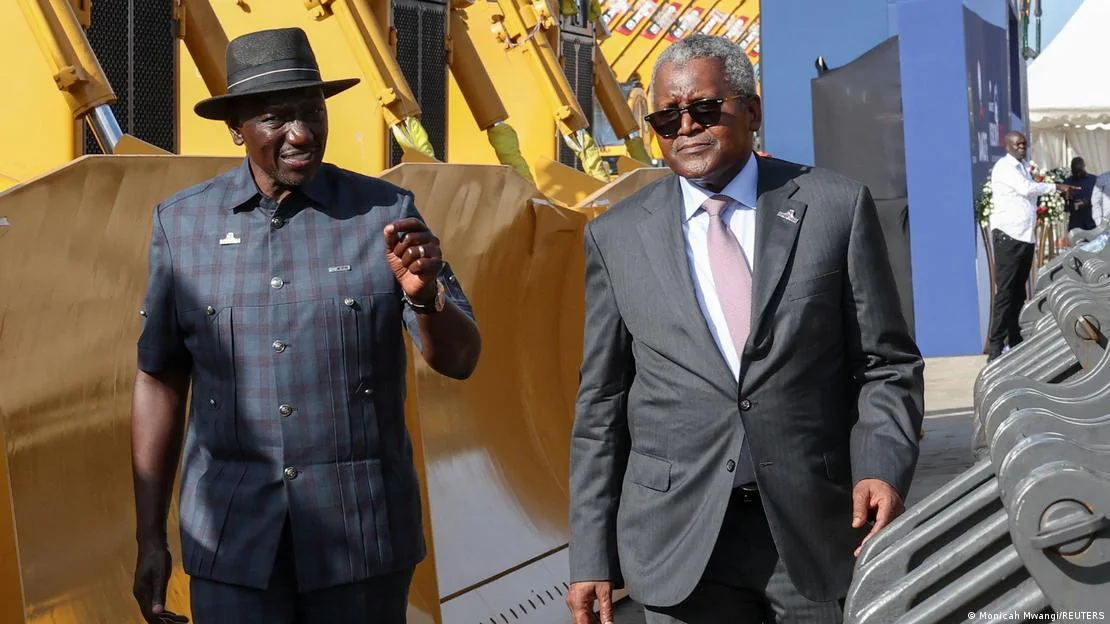
This week, Dangote broke ground on his first refinery in Kenya at Lamu. The facility could process up to 700,000 barrels of oil a day and may become Africa's second-largest refinery. At the Lamu ceremony, Dangote said the project is part of a broader $50 billion investment programme through 2030. This programme will cover infrastructure, minerals, ports, power, and petrochemicals, further solidifying Dangote's position as a major investor in Africa.
Dangote's conglomerate also supports pipeline projects linking Djibouti, Ethiopia, Namibia, Botswana, and South Africa. The group has built ports, trucking fleets, and storage facilities to control its supply chains from production to delivery. This integrated approach enables Dangote to optimize its operations and reduce costs. The company's extensive infrastructure investments are expected to have a significant impact on Africa's economic development.
Dangote Cement reported roughly $3 billion in revenue and $700 million profit for 2025. This financial performance illustrates the scale that underpins the conglomerate's expansion model. However, experts warn that the concentration of assets in a single conglomerate raises concerns about market dominance and pricing power. As Dangote continues to expand his business, regulatory scrutiny is likely to increase.
The Dangote Group's expansion plans are expected to reduce Africa's reliance on imported energy and boost industrial capacity. However, the company's growing influence in various sectors has sparked concerns about its potential impact on competition and market dynamics. As Africa's largest economy continues to evolve, the Dangote Group's role in shaping the continent's industrial landscape will be closely watched by investors, policymakers, and regulators.
Key points
- Dangote's conglomerate operates in at least 17 African countries, with a $50 billion investment plan through 2030.
- The new Lamu refinery project in Kenya could process up to 700,000 barrels of oil a day.
- Dangote Cement reported $3 billion in revenue and $700 million profit for 2025.