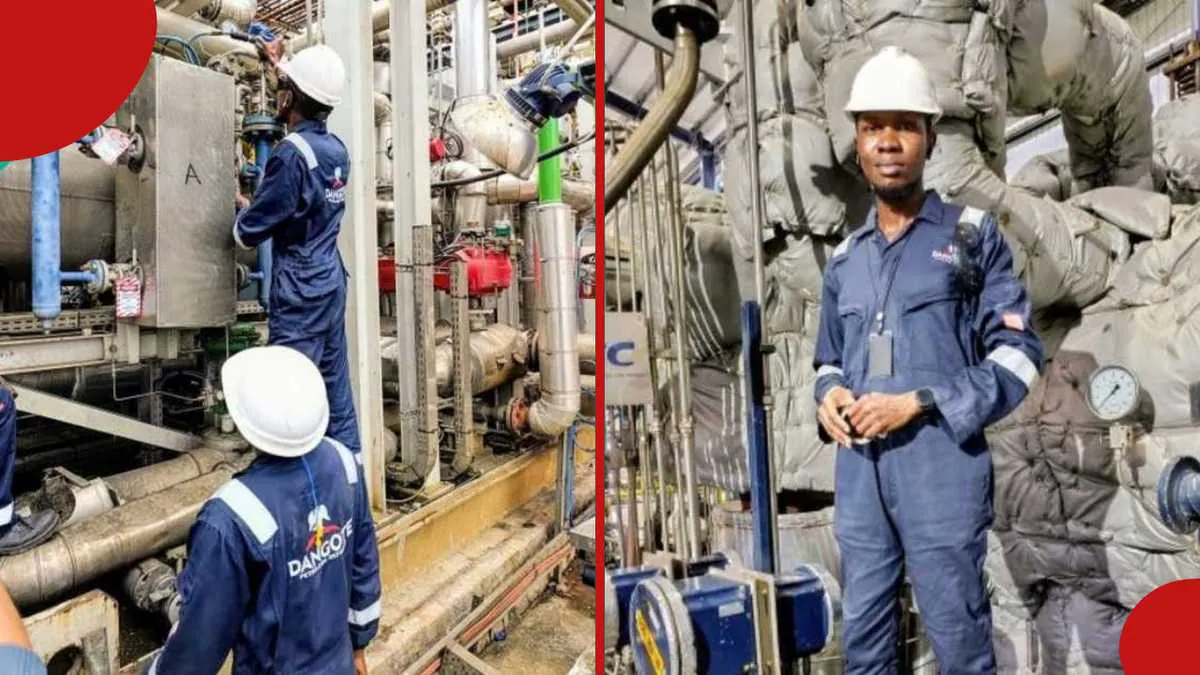
Markfred Akachukwu, an Instrumentation and Control Engineer at Dangote Petroleum and Petrochemicals Refinery, has shared his experience working at the facility's Captive Power Plant on LinkedIn. Akachukwu, who holds a degree in Electrical and Electronics Engineering from Michael Okpara University of Agriculture Umudike, said his hands-on experience has exposed him to practical lessons that classroom training could not fully provide. He worked across various systems, including gas turbine generators, heat recovery steam generators, and utility boilers.
Akachukwu's experience at the refinery has taught him to investigate carefully rather than reach for the quickest explanation when equipment appears to malfunction. He said interpreting loop diagrams and Piping and Instrumentation Diagrams has helped develop his technical judgement. His tasks have included working with transmitters, flame scanners, control valves, and analysers, as well as tracing signal loops and taking part in preventive maintenance.
Akachukwu highlighted the importance of tracing faults to their source, saying that an unusual reading or failed signal does not necessarily point to a faulty instrument or a problem in the process itself. He explained that fault-finding requires engineers to trace signals to their source, check conditions in the field, and inspect wiring and terminations before settling on a diagnosis. Understanding the process, he said, is also essential.
Akachukwu also gained valuable lessons from working alongside experienced technicians, including observing work at a junction box and asking questions about how systems operate. He described instrumentation as a discipline that calls for observation, logic, and responsibility. Each maintenance task, he added, has strengthened his safety awareness and understanding of process control.
Akachukwu's experience offers a reminder of the value of learning on the job, particularly for aspiring engineers in Kenya and elsewhere. His story highlights the difference between what is learned in the classroom and the practical demands of working in the field. Akachukwu ended his post by saying he was still learning, asking questions, and working hands-on.
Akachukwu is not the only Kenyan who has secured a job at Dangote Refinery. Alexander Hamilton, a mechanical engineering graduate, landed a job at the refinery after sending more than 350 applications over seven months. He described securing the position as the beginning of a new responsibility rather than the end of his career journey.
Akachukwu's story demonstrates the importance of hands-on experience in engineering. His experience at Dangote Refinery has shaped his approach to engineering, and he continues to learn and develop his skills. As he noted, "An instrument does not exist in isolation; it is part of a story the process is telling."
Key points
- Markfred Akachukwu's experience at Dangote Refinery highlights the value of hands-on experience in engineering.
- Akachukwu's story offers lessons for aspiring engineers in Kenya and elsewhere.
- His experience demonstrates the importance of tracing faults to their source and understanding the process.