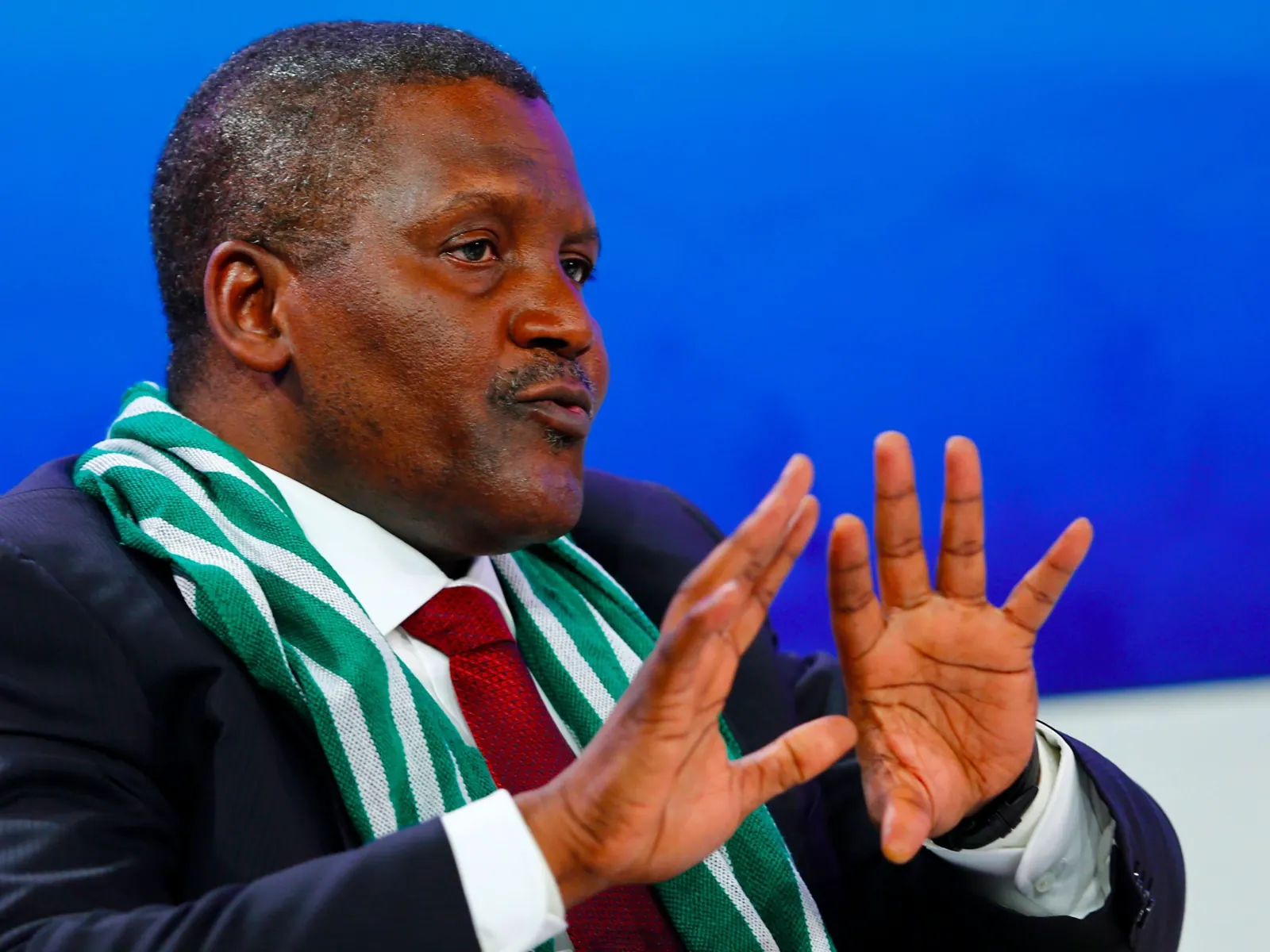
Dangote Group, a leading industrial conglomerate, has embarked on a $45bn investment programme to expand its businesses and reach $100bn in annual revenue by 2030. The programme, which is focused on disciplined and self-funded growth, will see the company's cement business, Dangote Cement, play a key role in driving growth. Dangote Cement plans to increase its production capacity from 55 million tonnes per annum to over 80 million tonnes.
Dangote Cement, the group's largest cash-generating business, has reported strong financial performance, with revenue reaching $3.1bn in the 12 months to June 2026, representing a 22 per cent year-on-year increase. The company's cash conversion stood at 89 per cent, while return on capital employed was 68 per cent, according to its September 2026 capital-markets presentation. Adjusted EBITDA recorded a 50 per cent compound annual growth rate between 2023 and 2025.
The company's strategy is described as capital-light, with existing production assets and logistics infrastructure providing a platform for growth beyond conventional cement. Dangote Cement plans to expand into cement-based adjacencies, including aggregates, mortars, dry mixes, and ready-mix concrete or precast products. This expansion will be driven by its African footprint, which spans 11 countries, with sales into 25 countries and 55Mta of installed capacity.
Dangote Cement's geographic revenue distribution shows that Nigeria accounted for 69 per cent of FY2025 revenue, while West Africa contributed 13 per cent, East Africa 12 per cent, and Southern Africa eight per cent. The company has also recorded significant export sales, with three million tonnes of export sales in 2025, and 34 clinker shipments dispatched from Nigeria to Ghana, Cameroon, Côte d'Ivoire, and a third-party customer in Gabon.
The company's revenue has risen sharply, from $1.5bn in 2023 to $2.4bn in 2024 and $2.9bn in 2025, before reaching $3.1bn in the 12 months to June 2026. Dangote Cement's large resource and logistics base will support its expansion, with about 4.2 billion tonnes of limestone reserves and an estimated 80-year mine life. Its flagship Obajana plant has 16Mta of installed capacity and about 1.0 billion tonnes of limestone reserves.
At the group level, the $45bn investment plan extends beyond cement into refining and petrochemicals, fertiliser, sugar, and other industrial businesses. Dangote Group is targeting $30bn in adjusted EBITDA by 2030, alongside its $100bn revenue objective. The company's ability to efficiently convert its existing operations into cash and capitalise on those returns as it expands will be crucial to its success.
For investors, the key financial issue is how efficiently Dangote converts its existing operations into cash and capitalises on those returns as it expands. The next test will be whether the company can maintain those levels of cash generation and capital efficiency as it moves towards more than 80Mta of capacity and the wider Dangote Group executes its $45 billion investment programme.
Key points
- Dangote Group's $45bn investment programme aims to drive growth and reach $100bn in annual revenue by 2030.
- Dangote Cement plans to increase its production capacity from 55 million tonnes per annum to over 80 million tonnes.
- The company's strategy is described as capital-light, with existing production assets and logistics infrastructure providing a platform for growth beyond conventional cement.