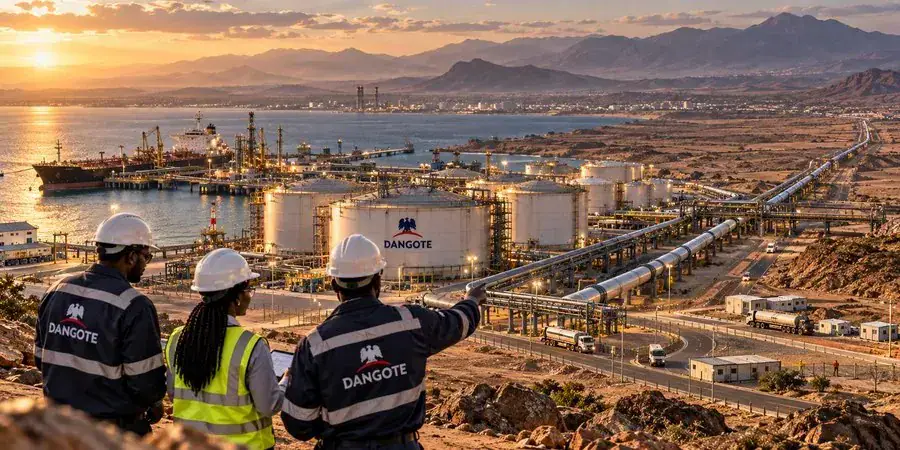
The Dangote Ethiopia pipeline, a significant privately led energy project in East Africa, was launched with a groundbreaking ceremony at the Damerjog Industrial Park on 24 September 2026. The event was jointly led by Dangote Group, Ethiopian Investment Holdings, and Djibouti authorities. High-profile attendees included Ethiopian Prime Minister Abiy Ahmed, Djiboutian President Ismaïl Omar Guelleh, and Dangote Group Chief Executive Aliko Dangote. The project aims to create a 120-kilometre multiproduct pipeline from marine and coastal facilities at Damerjog to inland storage and distribution infrastructure at Dewele.
The pipeline project has a combined petroleum-storage capacity of 400 million litres across both terminals. The first phase focuses on refined petroleum products, including the receipt, storage, transportation, and distribution of fuel along the corridor. This development replaces a road-heavy tanker route with a more predictable and continuous supply mechanism, addressing Ethiopia's strategic priority of fuel-supply reliability. The country's dependency on Djibouti for international trade makes this project crucial for importers, industry, and government.
The pipeline is expected to benefit various sectors, including aviation, transport, agriculture, construction, and manufacturing, with steadier fuel deliveries. More predictable supply allows for better inventory planning and reduces exposure to road disruption, congestion, and associated costs. Djibouti also gains incremental port activity and storage demand, adding a durable logistics anchor to the Damerjog Industrial Park. This development positions the zone for further investment and creates a significant commercial value on both sides of the border.
The structure of the deal places African private capital at the centre of a cross-border infrastructure project, signalling that regional energy corridors can attract and be led by continental investors. According to Aliko Dangote, the project advances Ethiopia's energy security while reinforcing Djibouti's role as the region's primary logistics hub. This combination creates durable commercial value and demonstrates a deliberate push to build integrated energy infrastructure across the continent.
Dangote Group is expanding its energy infrastructure investments elsewhere, having signed a contract worth over $450 million with Engineers India for consultancy and project-management services on a planned 700,000-barrel-per-day refinery and petrochemical complex in Lamu, Kenya. The Dangote Petroleum Refinery in Nigeria is targeting a capacity of 1.4 million barrels per day. These moves demonstrate the group's commitment to building integrated energy infrastructure across Africa.
The success of the Ethiopia-Djibouti pipeline project will depend on its execution, with key milestones including construction progress, terminal commissioning, and first commercial fuel flows. These datapoints will determine the pace of returns and the appetite for follow-on investment in shared East African energy corridors. Investors and policymakers should track construction progress, storage integration timelines, and early volume.
The project's impact on the region's energy landscape and its potential for replication in other East African countries will be closely monitored. With a focus on reducing costs and increasing efficiency, the Dangote Ethiopia pipeline is poised to become a model for future energy infrastructure projects in the region. As the project progresses, its effects on the local economy, energy security, and regional trade will become clearer.
Key points
- The Dangote Ethiopia pipeline project marks a significant milestone in East Africa's energy sector, with a $160 million investment in a 120-kilometre multiproduct pipeline.
- The project aims to improve fuel-supply reliability in Ethiopia and reinforce Djibouti's role as a regional logistics hub.
- The structure of the deal demonstrates the potential for African private capital to lead cross-border infrastructure projects in the region.