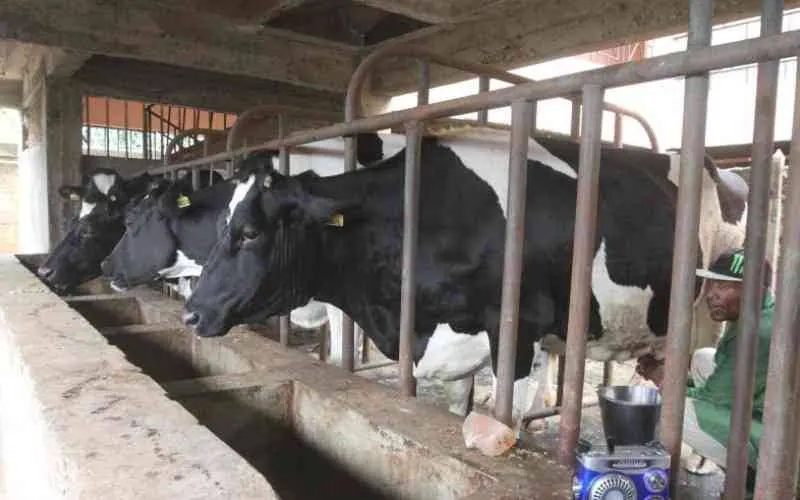
Kenya is experiencing a milk shortage due to reduced pasture and fodder availability caused by inadequate rainfall in some dairy-producing areas. Formal milk deliveries to processors declined from 84.4 million litres in June to 81.3 million litres in July, a 3.7 per cent drop. Preliminary indications show supply constraints continued into August. The shortage has affected consumers, with some retailers rationing fresh milk sales as processors struggle to secure adequate raw milk.
Agriculture and Livestock Development Cabinet Secretary Mutahi Kagwe attributed the decline in milk production to inadequate rainfall, which has affected pasture and animal feed. The reduced access to quality feed can lower milk yields, leaving farmers facing both declining production and higher costs. The problem begins long before milk reaches the supermarket shelf — in the feeding trough. When rains fail, pasture dries up, fodder becomes scarce, and the cost of maintaining productive animals rises.
Alex Gathii, founder and managing director of Tanolope Consultancy Ltd and Tanolope Dairy Academy, says the current shortage exposes a wider weakness in Kenya's dairy sector — poor fodder planning and inadequate conservation. He notes that farmers should conserve feed when it is abundant through practices such as maize silage and hay baling instead of allowing seasonal changes to dictate milk production. Gathii also calls for greater local production of feed ingredients such as sunflower and cotton to provide raw materials for animal-feed manufacturers.
Gathii emphasizes the importance of nutritional quality and balance in livestock feed. He categorizes livestock feeds into fillers, grasses and legumes, and basal feeds. Rice straw, wheat straw, and overgrown fodder provide bulk but have limited nutritional value, while legumes and grasses can form important components of livestock diets. For basal feed, he cites quality maize silage, fodder sorghum, and improved Napier varieties.
Githaiga Ngarry Kihara, chief executive officer of MooFodder Supermarket, promotes Trichanthera gigantea, a leafy fodder plant originally from Colombia, as a possible option for farmers facing prolonged dry spells. The crop is drought-resistant and can survive long periods with limited water. According to Kihara, the plant can provide an alternative source of protein, with a reported protein content of up to 23.7 per cent.
Kihara notes that Trichanthera gigantea is easy to propagate through stem cuttings rather than seeds. A farmer can take a stem cutting containing a node and plant it in moist soil under shade or a shade net. The young plant develops roots before being transferred to the field. This method allows farmers to easily cultivate the crop and potentially reduce production costs.
The milk shortage has sparked a renewed focus on livestock feed, with experts calling for improved fodder planning and conservation. As the dairy sector continues to face challenges, farmers and stakeholders are exploring alternative solutions to ensure a stable milk supply. The promotion of drought-resistant crops and improved feed practices aims to mitigate the effects of future droughts and support the dairy industry.
Key points
- Kenya's milk shortage is attributed to inadequate rainfall reducing pasture and fodder availability.
- Experts call for improved fodder planning and conservation to address the milk shortage.
- Alternative crops, such as Trichanthera gigantea, are being promoted as possible solutions for farmers facing drought.