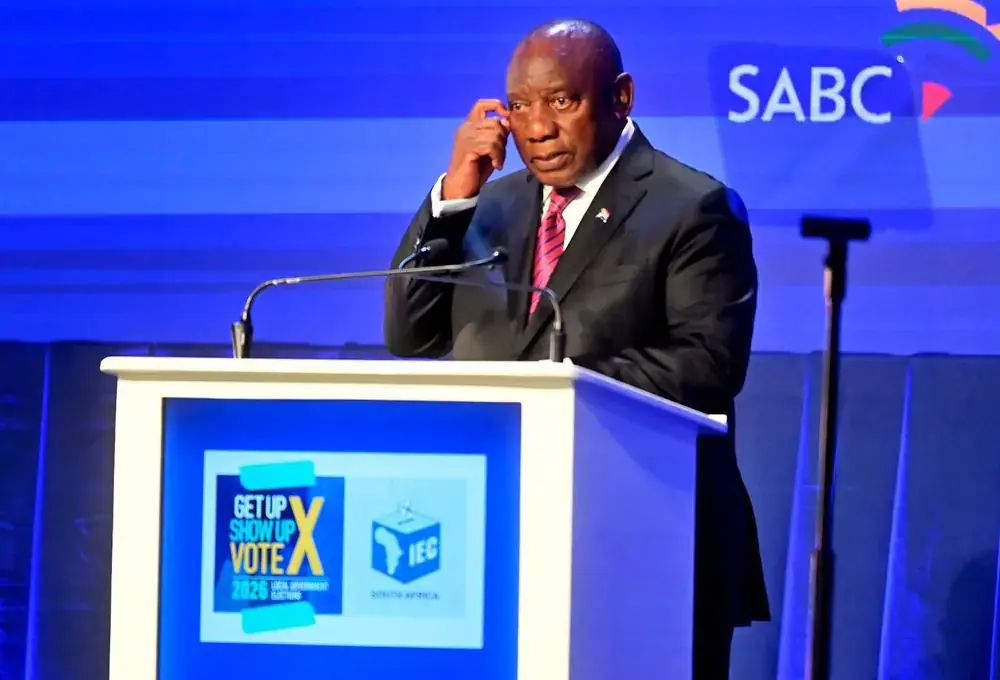
The 2026 Local Government Elections in South Africa have reshaped the country's political landscape, with the African National Congress (ANC) retaining its position as the largest party nationally but suffering further electoral setbacks. The Democratic Alliance (DA) emerged as the leading party in five of the country's eight metropolitan municipalities. President Cyril Ramaphosa has urged incoming councillors to prioritize service delivery over political power struggles, calling for mature coalition negotiations and a focus on residents' needs.
The ANC secured 30.76% of the national vote, followed by the DA on 24.64%. The MK Party came third with 9.76%, ahead of the Economic Freedom Fighters (EFF) on 6.22% and ActionSA on 5.67%. Approximately 14.9 million South Africans cast their ballots, representing a voter turnout of 52% – an increase of 6.1 percentage points from the 45.9% recorded in the 2021 Local Government Elections.
The DA led in Cape Town, Johannesburg, Tshwane, Ekurhuleni, and Nelson Mandela Bay, while the ANC led in Buffalo City and Mangaung. The MK Party topped the poll in eThekwini. Cape Town was the only metro where a party secured an outright council-seat majority, leaving the other seven facing coalition negotiations. In Johannesburg, the DA finished ahead with 34.8% of the vote, followed by the ANC on 20.3% and ActionSA on 16.3%.
The negotiations are already attracting attention, with reports that ActionSA wanted the DA to reconsider Helen Zille's candidacy for Johannesburg mayor. ActionSA leader Michael Beaumont has indicated that the party is not ruling out an arrangement involving Zille, although it has reservations about her suitability. Zille has indicated that she would favour a two-party coalition with either ActionSA or the ANC.
In Tshwane, the DA led with 34.4%, with ActionSA second on 22.1%, while Ekurhuleni also saw the DA emerge as the leading party with 30.7%. The DA secured 44.2% in Nelson Mandela Bay, while the ANC led in Buffalo City with 41.9% and Mangaung with 33.9%. In Mangaung, the DA was close behind on 33.5%.
The most significant shift in KwaZulu-Natal was in eThekwini, where the MK Party emerged as the biggest party with 86 of the metro's 223 council seats. However, the party fell short of the 112 seats required for an outright majority. The DA secured 57 seats, followed by the ANC with 37, the Inkatha Freedom Party (IFP) with 15, ActionSA with seven, and the EFF with four.
President Ramaphosa has urged political parties to approach coalition negotiations with maturity and humility, warning against treating municipal positions and privileges as the primary objective. He emphasized that essential service delivery should never become a bargaining tool in coalition negotiations, and that voters expect functioning councils, capable administrations, and leadership that can rise above political differences.
Key points
- The ANC's support has declined in successive elections amid growing frustration over municipal service delivery and political instability.
- The DA has emerged as the leading party in five of South Africa's eight metropolitan municipalities.
- Coalition negotiations are set to determine who governs several key cities, with smaller parties such as ActionSA emerging as influential players.