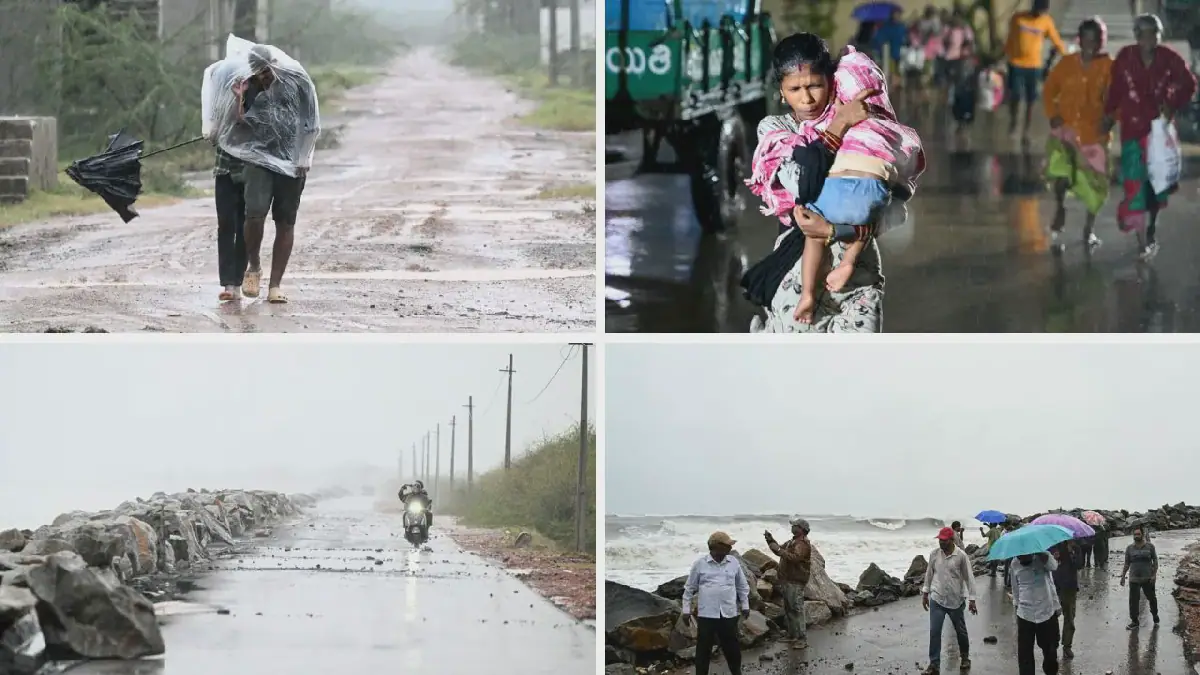
Cyclone Arnab made landfall in southeast India on Wednesday morning, bringing with it strong winds and torrential rains. The storm, classified as "very severe" by the Indian Meteorological Department (IMD), had its center located in the extreme south of the state of Andhra Pradesh, with wind gusts reaching up to 140 km/h. The IMD reported that the storm was expected to cause significant damage to coastal areas.
In preparation for the storm, authorities in Andhra Pradesh and neighboring Odisha state evacuated nearly 100,000 people from coastal areas on Tuesday. The evacuations were carried out to prevent casualties from the storm's expected impact. As of Wednesday morning, no casualties had been reported, according to the office of the chief executive of Andhra Pradesh. The authorities praised their agents for working tirelessly throughout the night to prepare for the storm.
The storm brought powerful waves to the coast throughout the night, causing significant damage to coastal areas. A merchant from the city of Kakinada, Hussein, reported that there was not too much damage, but that the sea was rough and several trees had fallen, with some huts and fences damaged. Another resident, Sadiq, reported that many roads were flooded, with one of his friends having to take refuge in a higher temple.
The IMD warned that Cyclone Arnab could cause the total destruction of thatched roof houses, localized flooding, and the downing of power and communication poles. The storm is also expected to cause significant damage to crops. The IMD's warning was echoed by the National Disaster Management Authority, which urged people to take necessary precautions.
Cyclones are a recurring threat in the Bay of Bengal and northern Indian Ocean, but this year's storm season has been particularly intense, fueled by a powerful El Niño phenomenon. Scientists agree that global warming is increasing the severity and frequency of extreme weather events. The IMD has been issuing alerts and warnings to affected areas.
The impact of Cyclone Arnab was not limited to India, with the Sri Lankan military deployed and schools closed on Tuesday due to rain alerts. The Department of Meteorology warned of the risk of floods and landslides. In Nepal, the National Disaster Management Authority issued an alert, warning that the storm would move inland towards the Himalayas, bringing heavy precipitation and a high risk of snowstorms and avalanches.
Tourists have been advised to avoid traveling to high mountain areas, and those already in the area have been instructed to stay in safe locations. Nepal is still recovering from a deadly flood on August 26, caused by the collapse of a glacier and a mountain, which killed over 1,400 people and left over 5,000 missing. The country's authorities are taking steps to mitigate the impact of Cyclone Arnab.
Key points
- Nearly 100,000 people were evacuated from coastal areas in Andhra Pradesh and Odisha state in preparation for the storm.
- Cyclone Arnab is expected to cause significant damage to crops and coastal areas, with the IMD warning of the total destruction of thatched roof houses and localized flooding.
- The storm is part of a particularly intense storm season, fueled by a powerful El Niño phenomenon and exacerbated by global warming.