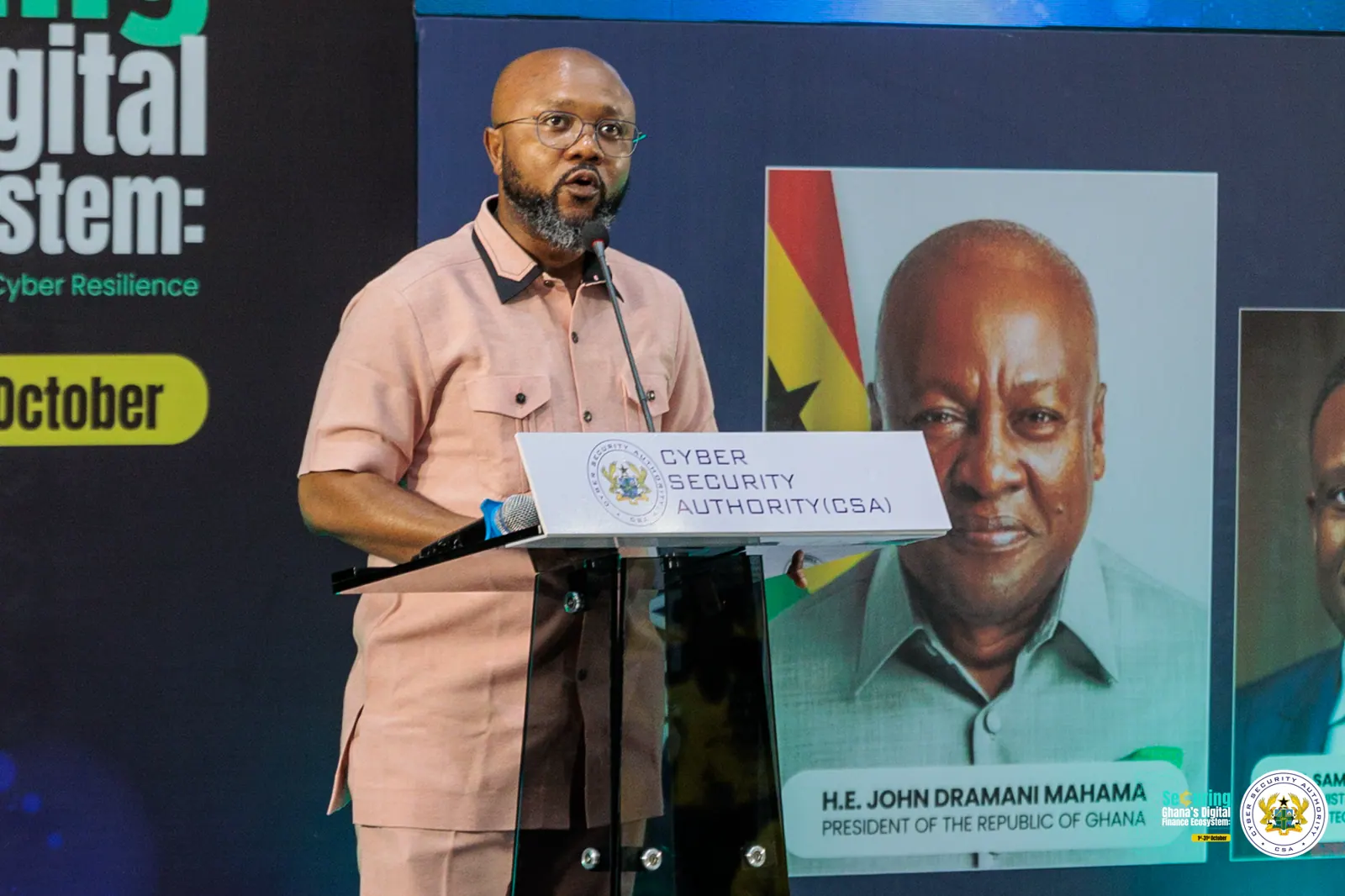
Director-General of the Cyber Security Authority (CSA), Divine Selase Agbeti, has emphasized the need for stronger collaboration among financial institutions, telecommunications companies, fintechs, regulators, and law enforcement agencies to safeguard Ghana's growing digital economy. This call was made during the launch of the 2026 National Cyber Security Awareness Month (NCSAM) on October 1, 2026. The theme of the event was "Securing Ghana's Digital Finance Ecosystem: Building Trust Through Collaboration and Cyber Resilience."
Mr. Agbeti stressed that cybersecurity can no longer be viewed solely as an information technology issue but must be regarded as an economic and national security concern. Ghana's increasing reliance on mobile money, digital banking, online shopping, and digital public services has created new opportunities but also heightened the country's exposure to cybercrime. The same technology that facilitates easy transactions can be exploited by criminals to commit fraud.
The Director-General warned that artificial intelligence is being used to create convincing impersonations, phishing messages, and sophisticated social engineering attacks. He highlighted that the impact of cybercrime extends beyond financial losses, as victims can lose confidence in digital platforms. "When a Ghanaian loses money to cyber fraud, we lose more than money. We lose confidence," he said.
Mr. Agbeti emphasized that there can be no sustainable digital economy without digital trust and no digital trust without cybersecurity. He called for more effective information sharing among institutions, noting that cybercriminals often exploit gaps between organizations. Banks, fintech companies, telecommunications operators, regulators, technology companies, and law enforcement agencies must share threat intelligence quickly to prevent attacks and reduce losses.
The Director-General urged boards and chief executives of financial and digital institutions to take greater responsibility for cybersecurity. He stated that cyber risk should be treated as a business risk and not left solely to technology departments. "Resilience is not the absence of attacks. Resilience is the ability to anticipate them, withstand them, recover from them and emerge stronger," he said.
Mr. Agbeti warned cybercriminals that the CSA, together with law enforcement, intelligence, regulatory, and international partners, would continue to strengthen Ghana's capacity to identify, investigate, and disrupt cyber-enabled crime. He assured that technology does not place criminals beyond accountability. The public was also urged to take simple precautions when using digital financial services, including verifying payment requests and protecting passwords and authentication credentials.
The growing use of artificial intelligence means people can no longer be complacent about cybersecurity. With the increasing threats, it is essential for all stakeholders to work together to build a resilient digital economy. The CSA and its partners are committed to protecting Ghana's digital landscape and ensuring that the country's digital economy continues to thrive in a secure environment.
Key points
- Cybersecurity is a national priority that requires collaboration among financial institutions, telecommunications companies, fintechs, regulators, and law enforcement agencies.
- The impact of cybercrime extends beyond financial losses to include loss of confidence in digital platforms.
- Effective information sharing among institutions and a business approach to cyber risk are essential for building a resilient digital economy.