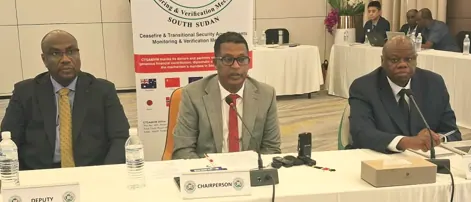
The Ceasefire and Transitional Security Arrangements Monitoring and Verification Mechanism (CTSAMVM) has expressed concern over the security situation in South Sudan, citing renewed clashes involving organized forces, armed youth mobilization, and intercommunal violence. According to Maj. Gen. Dr. Hailu Endashaw Atomsa, chairperson of CTSAMVM, the security situation remains unpredictable across several parts of the country. This was stated during the mechanism's eighth Technical Committee Meeting held on Tuesday.
Gen. Endashaw highlighted three clear trends that have emerged: renewed confrontations involving organized forces, continued mobilization of armed youth, and intercommunal violence. These developments have resulted in growing impacts on civilians, including displacement, movement restrictions, and humanitarian access challenges. The CTSAMVM chairperson also noted that road insecurity remains a concern in Central Equatoria State, where there have been reported ambushes and attacks against civilians.
In Upper Nile, the situation is particularly concerning in Ulang and Nasir counties, where reported clashes involving the SSPDF, SPLM/A-IO, and the White Army resulted in casualties, displacement, and restrictions on movement. Additionally, armed youth violence continued to affect communities in Jonglei and the Greater Pibor Administrative Area, including reported child abductions along the Bor-Pibor-Duk corridor. These incidents have raised concerns about the protection of civilians.
The CTSAMVM chairperson also highlighted protection concerns in Unity State following the reported shooting of civilians at the Bentiu Protection of Civilians site. In Warrap State, intercommunal violence in Tonj North and further killings in Gogrial East have increased the risk of retaliation and localized insecurity. These developments continue to place pressure on the Permanent Ceasefire, particularly in Upper Nile, Warrap, and parts of Central Equatoria.
To monitor the situation, the Monitoring and Verification Team in Juba completed a long-duration air patrol to Kapoeta from September 7 to 11 and investigated an alleged SPLM/A-IO attack on a police headquarters and the reported arrest of the son of a former SPLM/A-IO county commissioner. Another long-duration patrol to Lobonok in Juba County is planned for October. The Technical Committee is considering two verification reports, including armed confrontations between the SSPDF and SPLM/A-IO in Burbiey and Jikmir in Nasir County, Upper Nile State.
CTSAMVM has called for measures to prevent further escalation, including senior commanders of the Parties maintaining direct communication, exercising restraint, and preventing further movements toward opposing positions. The mechanism also called for stronger measures to protect civilians, safeguard freedom of movement, and secure key civilian and humanitarian routes. Expanded early-warning and local conflict-resolution efforts are proposed to reduce armed youth mobilization and recover illicit firearms.
CTSAMVM also emphasized the need for prompt investigations into allegations involving organized forces, including attacks against civilians and conflict-related sexual violence, with appropriate follow-up where allegations are substantiated. The mechanism reiterated its commitment to advancing the implementation of Chapter II of the Revitalized Peace Agreement and contributing to a more peaceful, stable, and secure South Sudan.
Key points
- CTSAMVM reports unpredictable security situation in several parts of South Sudan
- Renewed clashes involving organized forces, armed youth mobilization, and intercommunal violence have resulted in growing impacts on civilians
- CTSAMVM calls for measures to prevent further escalation and protect civilians