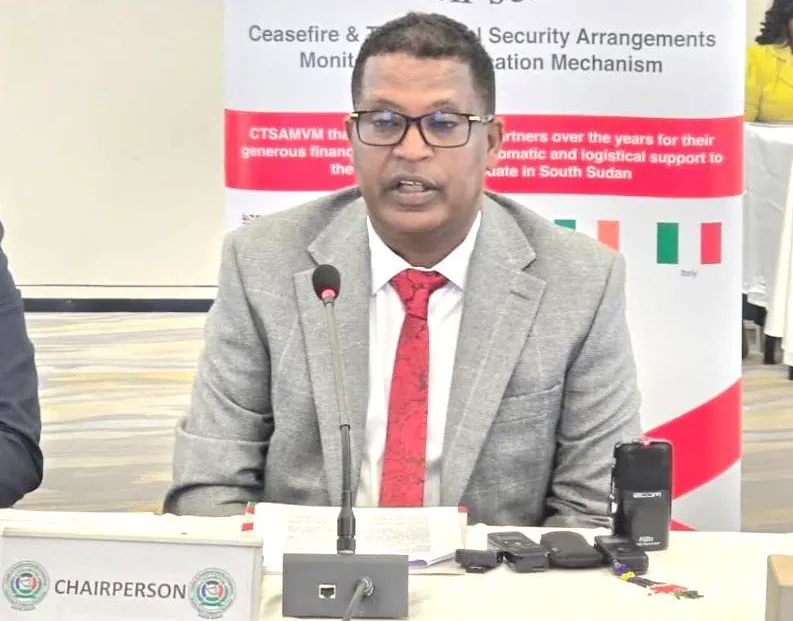
The security situation in several parts of South Sudan remains unpredictable, with localized violence, abductions, armed clashes, and attacks along key roads continuing to threaten civilians and humanitarian operations. This was revealed by Major General Dr. Hailu Endashaw Atomsa, Chairperson of the Ceasefire and Transitional Security Arrangements Monitoring and Verification Mechanism (CTSAMVM), during the opening of the mechanism's 8th Technical Committee Meeting at Dembesh Hotel in Juba. Gen. Atomsa expressed concerns over the ongoing insecurity in various regions.
Gen. Atomsa cited specific areas of concern, including Central Equatoria, where road insecurity remained a challenge due to reported ambushes and attacks against civilians. In Upper Nile, the situation was particularly worrying in Ulang and Nasir, where clashes involving the South Sudan People's Defence Forces (SSPDF), the Sudan People's Liberation Movement-in-Opposition (SPLM/A-IO), and the White Army resulted in casualties, displacement, and movement restrictions. These incidents have undermined the implementation of the peace agreement and the protection of civilians.
Although major military confrontations have declined in some areas, persistent localized insecurity continues to pose a threat. Gen. Atomsa highlighted security concerns in Greater Upper Nile, Jonglei, Central Equatoria, and other parts of the country, including armed clashes, intercommunal violence, cattle-related conflicts, abductions, forced recruitment, and road ambushes. CTSAMVM has been actively monitoring and investigating these incidents to verify reports and assess the situation on the ground.
In Upper Nile, CTSAMVM has been monitoring reported incidents in Nasir County, while in Central Equatoria, its monitoring teams have investigated reported attacks and abductions along the Yei area and surrounding routes. The mechanism also conducted air patrols to areas including Mandeng in Nasir County to verify reported security incidents. These efforts aim to ensure that parties to the peace agreement cooperate with investigations into alleged violations.
Gen. Atomsa stressed the importance of sustained political commitment, dialogue, and communication among commanders and other stakeholders to prevent local disputes from escalating into wider conflict. He emphasized the need to protect civilians and humanitarian personnel, maintain access to key transport corridors, and ensure cooperation with investigations into alleged violations. The chairperson also highlighted the challenges faced by CTSAMVM, including financial and operational constraints.
The 8th Technical Committee Meeting is considering verified reports concerning security incidents, including clashes in Nasir County and an attack in Atende Boma in Central Equatoria, in which a local sub-chief and youths were reportedly abducted. CTSAMVM previously reported that its Juba team conducted a long-duration patrol to Yei to investigate the reported abduction of the Atende Boma sub-chief and several youths. The meeting aims to strengthen security, protect civilians, and consolidate the peace process.
Gen. Atomsa formally declared the 8th Technical Committee Meeting open, urging participants to work collectively toward strengthening security, protecting civilians, and consolidating the peace process. He called for stronger measures to prevent violations, protect civilians, and hold perpetrators accountable. The meeting comes as South Sudan continues efforts to implement the Revitalized Agreement on the Resolution of the Conflict in South Sudan, with CTSAMVM maintaining that cooperation among the parties remains essential to sustaining the permanent ceasefire.
Key points
- The security situation in South Sudan remains unpredictable due to localized violence, abductions, and armed clashes.
- CTSAMVM is working to monitor and verify security incidents, but faces financial and operational constraints.
- The mechanism is urging sustained political commitment, dialogue, and communication to prevent local disputes from escalating into wider conflict.