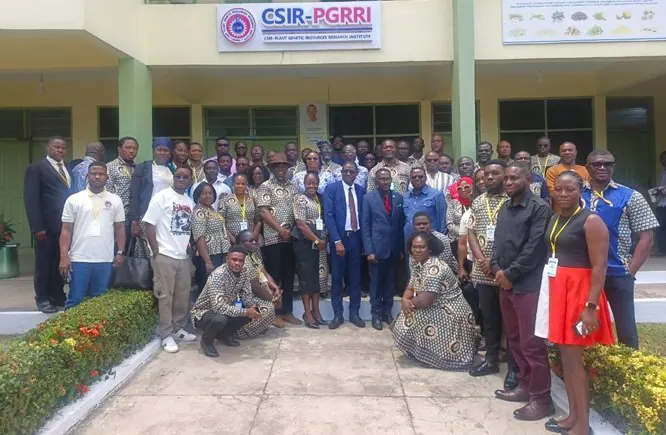
The Council for Scientific and Industrial Research (CSIR) in Ghana is facing a significant challenge as thousands of acres of its lands are being lost to encroachers. This development is depriving the institution of assets that could generate substantial revenue to support scientific research and innovation. The situation has been described as critical, with calls for urgent intervention from the government, Lands Commission, and other relevant institutions to reclaim and protect the lands.
According to Dr. Daniel Asenso-Gyambibi, Dean of Directors of the CSIR and Director of the Building and Roads Research Institute (BRRI), the encroachment issue is widespread across various CSIR facilities. The Animal Research Institute, which initially had over 1,100 acres, now has only about 200 acres remaining. Similarly, the Institute of Industrial Research at Isilegon has lost a substantial portion of its original 450 acres and is now left with only 33 acres.
The CSIR Head Office at the Airport Enclave, which previously had about 81 acres, now has approximately 50 acres. Dr. Asenso-Gyambibi also cited the CSIR facility at Enyinase, which had more than 800 acres, but about half of the land has been lost. In Kumasi, the CSIR had 1,441 acres, but about 750 acres have been taken without the institution deriving any economic value from them.
The financial implications of the lost lands are significant. Dr. Asenso-Gyambibi stated that an acre of land at the Accra location is valued at about $2 million. Therefore, the lands lost could have generated about $60 million for the CSIR if they had been properly transformed into economic assets. This substantial revenue could have supported scientific research and innovation.
The encroachment issue is attributed to various factors, including actions by chiefs and individuals, as well as forced takeovers of some CSIR lands. Dr. Asenso-Gyambibi emphasized that the situation requires a collective effort by the CSIR, Lands Commission, and government to halt further encroachment and reclaim the lands. However, the CSIR cannot independently deal with the situation because the lands belong to the government.
The National President of the CSIR Senior Staff Association, Mr. Edward Kissi, highlighted the critical role of senior staff in research, administration, technical services, laboratory operations, and knowledge transfer. He called for sustained investment in professional development, adequate resources, motivation, and career progression to enable senior staff to contribute effectively to the CSIR's mandate.
Other stakeholders, including Dr. Daniel Ashie Kortey, Director of CSIR Plant Genetic Resources, emphasized the importance of senior staff as the backbone of CSIR. They identified staff attrition, an ageing workforce, skills gaps, limited career progression, and funding constraints as major challenges affecting senior staff. Addressing these challenges is crucial to sustaining research, innovation, and operations at CSIR.
Key points
- The CSIR has lost thousands of acres of land to encroachers, depriving the institution of potential millions of dollars.
- The situation requires a collective effort by the CSIR, Lands Commission, and government to halt further encroachment and reclaim the lands.
- Senior staff play a critical role in research, administration, technical services, laboratory operations, and knowledge transfer at CSIR.