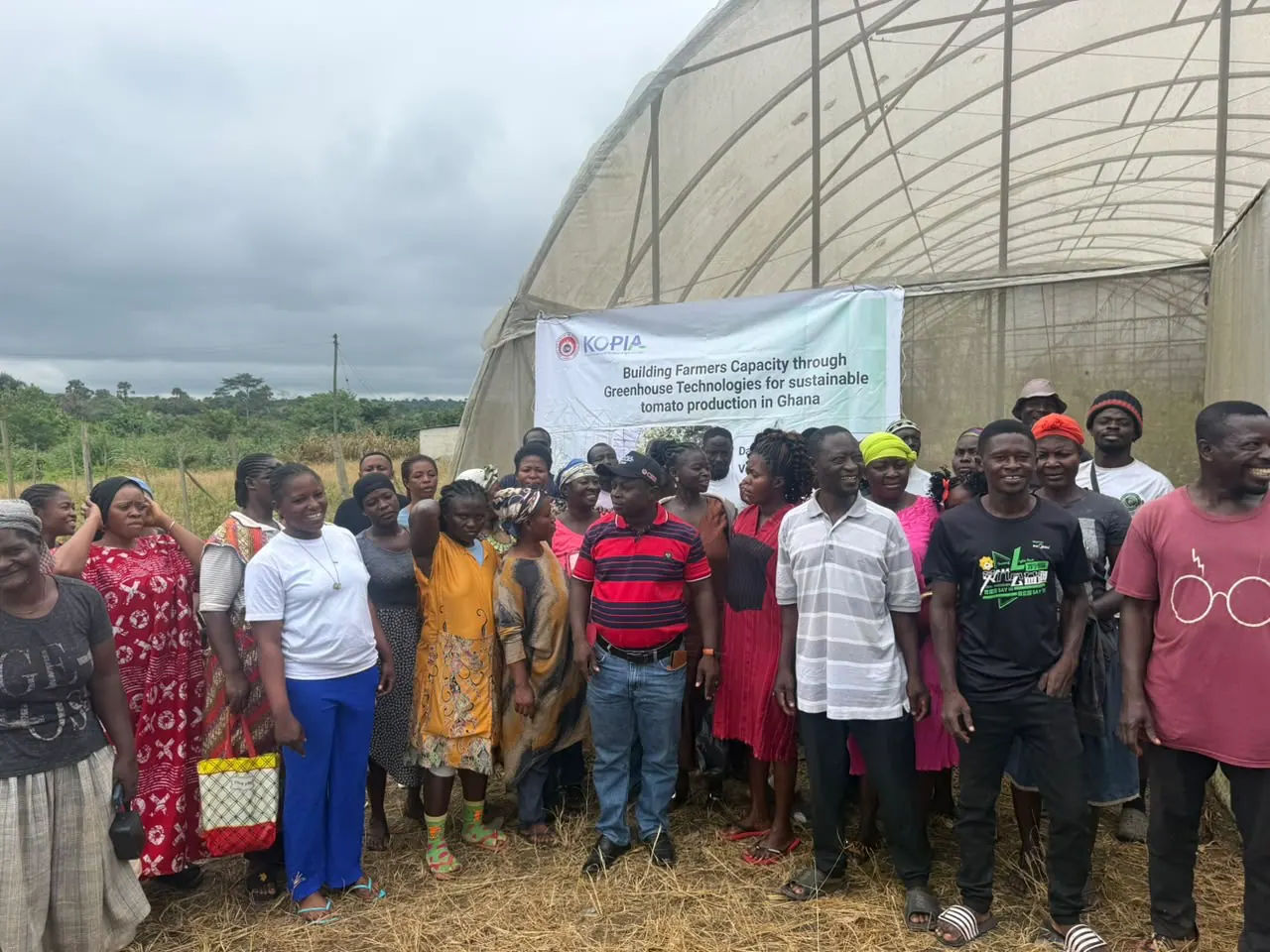
The Council for Scientific and Industrial Research-Crops Research Institute (CSIR-CRI) in collaboration with KOPIA Ghana has initiated a training program for over 100 farmers and agricultural extension officers on greenhouse tomato production. This project aims to reduce Ghana's reliance on imported tomatoes and move towards self-sufficiency in tomato production. The training sessions were conducted in two separate events at Akumadan in the Offinso North District and Dormaa East in the Bono Region.
Dr. Michael Kwabena Osei, Principal Research Scientist and Tomato Breeder at CSIR-CRI, highlighted that the project focuses on evaluating climate-smart tomato lines, demonstrating improved varieties, and enhancing farmer capacity in greenhouse technologies. He noted that open-field tomato production often results in low yields, poor quality, and high pest and disease pressure. In contrast, greenhouse varieties available in the market are expensive hybrids.
To address these challenges, CSIR-CRI has developed affordable inbred and open-pollinated lines that yield comparably to expensive hybrids. Dr. Osei emphasized that with low-cost screenhouses built from local materials, farmers can produce high-quality tomatoes year-round, thereby reducing imports. The training program included practical sessions covering aspects from nursery to harvest.
These practical sessions included seed tray nursery with insect nets to prevent whitefly-transmitted Tomato Yellow Leaf Curl Virus (TYLCV), use of yellow traps for pest monitoring, trellising/staking, drip irrigation, fertigation, and disease management. Mr. Prosper Adelwini, the District Director of Agriculture, Offinso North, commended CSIR-CRI and KOPIA Ghana for the practical sessions, describing the training as timely.
Farmers who participated in the training expressed their appreciation for the knowledge gained. Madam Akosua Serwaa, a farmer from Dormaa East, noted that the training has shown them how tomatoes can be grown cleanly and neatly inside greenhouses. She suggested that assistance with seeds and building their own greenhouses would help them avoid poor marketing during gluts.
The training program is expected to contribute significantly to Ghana's goal of achieving self-sufficiency in tomato production. By equipping farmers with the skills and knowledge to produce high-quality tomatoes in greenhouses, the project aims to reduce the country's reliance on imported tomatoes. This initiative is also expected to improve the livelihoods of farmers and enhance food security.
The collaboration between CSIR-CRI and KOPIA Ghana reflects a broader effort to support sustainable agricultural practices and enhance food production in Ghana. The project's focus on climate-smart technologies and affordable solutions is particularly relevant in the context of Ghana's efforts to adapt to climate change and ensure sustainable food systems.
Key points
- Over 100 farmers and agricultural extension officers trained on greenhouse tomato production
- Training aims to reduce Ghana's reliance on imported tomatoes and achieve self-sufficiency in tomato production
- Affordable inbred and open-pollinated lines developed by CSIR-CRI to enhance tomato yields