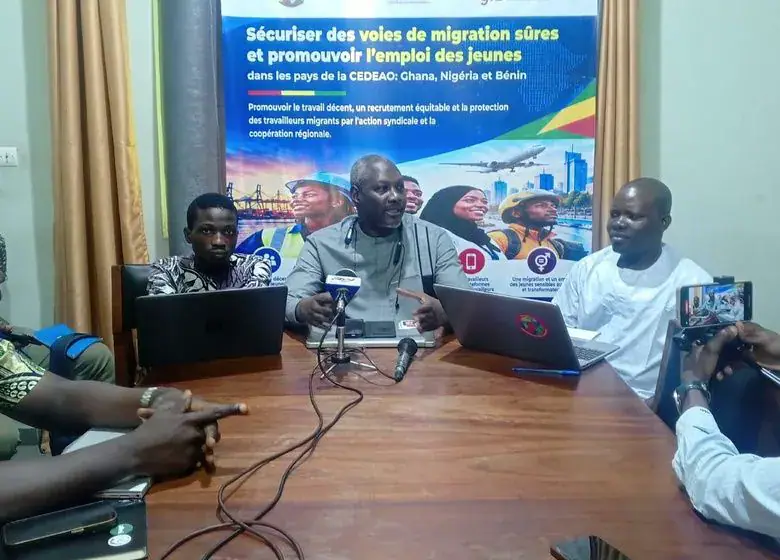
The Confédération syndicale internationale-Afrique (CSI-Afrique) has launched a project aimed at securing the migration of young people in West Africa. The project, supported by German cooperation through GIZ, seeks to provide young people with the means to find employment in their home countries while ensuring they can migrate safely when desired. The initiative was presented on November 19, 2026, in Cotonou, Benin.
The project targets Benin, Ghana, and Nigeria, with a focus on the Ghana-Nigeria-Benin corridor and potential involvement of Togo. Its goal is to make regional mobility a safer and more informed process, respecting workers' rights. The project aims to combat recruitment abuses, improve access to information, and strengthen links between trade unions in departure and host countries.
Abdou Karim Ouédraogo, CSI-Afrique program coordinator, emphasizes that migration should be a prepared and informed decision. Workers should know their destination, living conditions, contract, administrative obligations, and applicable rules in the host country. They should also inform their trade union to receive support in case of difficulties. The project plans to strengthen ties between trade unions in different countries to provide protection to migrant workers.
The project seeks to address the root causes of migration by creating employment opportunities in home countries. Ouédraogo explains that the initiative aims to enable young people to multiply employment opportunities in their own countries, making migration a choice rather than a necessity. Several activities have already been launched, including training for young people and a sub-regional workshop in Abuja, Nigeria.
In Benin, young trade unionists plan to focus on awareness-raising campaigns about employment opportunities. Their campaign, "Un emploi décent au Bénin, c’est possible" (A decent job in Benin is possible), aims to reach 1,000 young people aged 18-35 through various media channels. The message is clear: "Young people, there is work for you in your own country."
The project also aims to address obstacles to free movement in the region. Ouédraogo highlights disparities in controls between Benin and Nigeria, despite the Economic Community of West African States (ECOWAS) protocols providing for free movement of persons and goods. The project recommends revisiting existing agreements and adapting them to current realities.
The initiative's long-term goal is to make the migratory corridor more operational and sustainable, with effective cooperation between concerned countries. CSI-Afrique emphasizes that mobility should not be limited to labor movement but must be accompanied by guaranteed rights, decent work, and effective protection before departure, during transit, in the host country, and upon return.
Key points
- The project aims to provide young people with employment opportunities in their home countries, making migration a choice rather than a necessity.
- The initiative seeks to strengthen ties between trade unions in different countries to provide protection to migrant workers.
- The project recommends revisiting existing agreements to adapt them to current realities and address obstacles to free movement in the region.