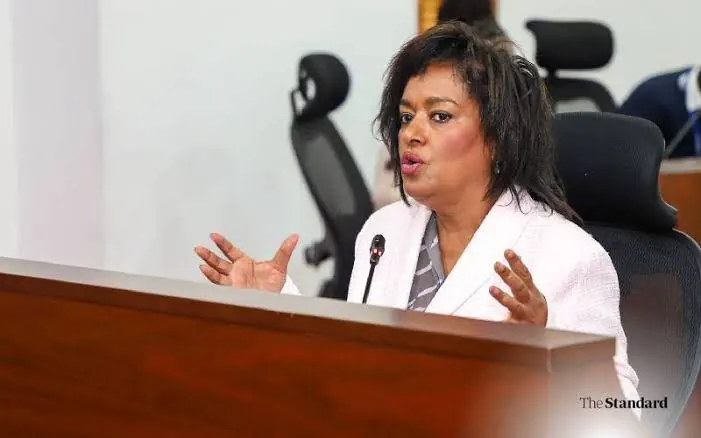
Kenyan Woman Representative Esther Passaris has expressed concerns about gender-based political violence, specifically accusing DCP boss Rigathi Gachagua of bullying female incumbents and aspirants. She made these claims during a press conference at the Parliament Buildings, suggesting that Gachagua has a personal vendetta against women politicians. However, Passaris provided no evidence to support her allegations, leading some to question her motives.
The issue of gender-based violence in politics is complex and multifaceted. While some politicians, like Passaris, have raised concerns about the objectification of women in politics, others have highlighted the need for women to be judged on their performance rather than their physical attributes. For instance, Sirisia MP John Waluke recently sparked controversy by asking women aspirants to "turn round" so that voters could "vet" them. This incident highlights the challenges women face in Kenyan politics.
Passaris has a history of engaging in high-profile conflicts with other politicians. She has clashed with Naivasha MP Jayne Kihara on TV and had a public spat with Miguna Miguna on KTN in 2016. Her recent comments on the state of roads in Homa Bay County, where she claimed that roads undergoing repairs were being improved, have also raised questions about her credibility.
The conversation around women's roles in Kenyan politics is ongoing. While some women politicians, like Passaris, have called for greater representation and protection, others have emphasized the need for women to compete for top offices without relying on affirmative action. Martha Karua, the leader of the Progressive Liberal Party, and former Kitui Governor Charity Ngilu are often cited as examples of women who have successfully navigated Kenyan politics without relying on quotas.
The two-thirds gender rule, enshrined in the Kenyan Constitution, aims to promote gender balance in politics. However, its implementation has been inconsistent, and some have argued that it has created more problems than it has solved. The role of women in Kenyan politics is complex, and there are varying opinions on how to achieve greater representation and equality.
President William Ruto's pledge to adopt a gender-balanced running-mate formula for the UDA party has sparked debate. While some have welcomed the move as a step towards greater gender equality, others have questioned its implementation. With the next elections approaching, it remains to be seen whether Ruto's pledge will be fulfilled and what impact it will have on Kenyan politics.
The legacy of women politicians in Kenya is multifaceted. While some, like Passaris, have been involved in high-profile controversies, others have made significant contributions to Kenyan politics. As the country moves towards the next elections, it is essential to continue the conversation on women's roles in politics and how to promote greater equality and representation.
Key points
- Esther Passaris's claims of gender-based violence in politics have sparked debate on the role of women in Kenyan politics.
- The implementation of the two-thirds gender rule has been inconsistent, and its impact on Kenyan politics is still being debated.
- President William Ruto's pledge to adopt a gender-balanced running-mate formula for the UDA party has sparked debate on the future of women's representation in Kenyan politics.