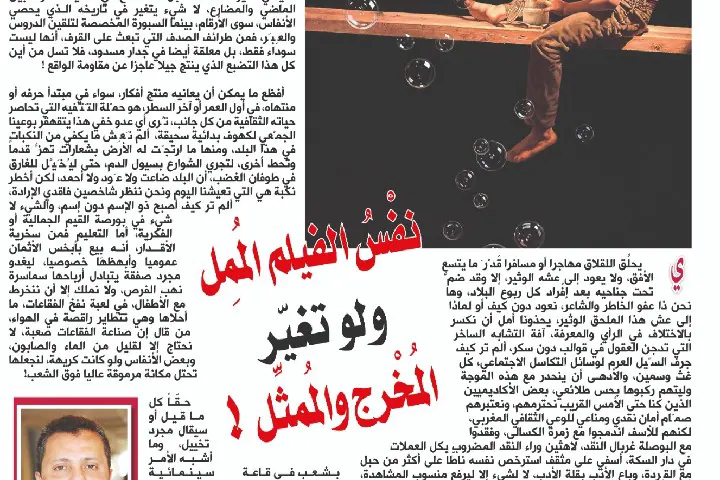
A recent article in the Moroccan newspaper Al-Alam's cultural supplement, "Al-Ilm al-Thaqafi," has sparked controversy with its scathing criticism of the current state of Moroccan culture and media. The article, written by Mohamed Bashkar, laments the decline of intellectual and cultural standards in Morocco, citing the proliferation of social media and the homogenization of cultural expression. Bashkar argues that this has led to a situation where "the same dull film is being repeated, even if the director and actors change."
Bashkar's criticism is directed not only at the general public but also at some academics and intellectuals who he believes have abandoned their critical faculties and are now more concerned with self-promotion and financial gain. He expresses disappointment that some respected academics have joined the ranks of those who prioritize sensationalism and triviality over meaningful cultural and intellectual engagement. This, he argues, has contributed to the degradation of Moroccan cultural and intellectual life.
The article also touches on the theme of the loss of trust in institutions and ideologies in Moroccan society. Bashkar notes that the dominance of a consumerist and materialistic worldview has led to widespread disillusionment and a sense of hopelessness among many Moroccans. He argues that this has resulted in a situation where people are no longer able to think critically or imagine alternative futures, and are instead trapped in a cycle of repetition and stagnation.
Bashkar's critique of Moroccan culture and media has resonated with some readers, who see it as a reflection of their own frustrations and concerns about the state of the country. However, others have criticized the article for its tone and language, which they see as overly pessimistic and dismissive. The debate highlights the complex and contested nature of cultural and intellectual life in Morocco, and the challenges of navigating the country's rapidly changing social and economic landscape.
The article has also sparked a wider conversation about the role of culture and media in Moroccan society, and the need for greater critical engagement and intellectual curiosity. Some have called for a renewed focus on promoting cultural and intellectual diversity, and for supporting independent and critical voices in the media. Others have emphasized the importance of addressing the social and economic issues that underlie the cultural and intellectual malaise.
The controversy surrounding Bashkar's article has also highlighted the challenges faced by Moroccan intellectuals and cultural producers in navigating the country's complex and often fraught cultural landscape. Many have expressed concern about the pressures and constraints that they face, including censorship, self-censorship, and the need to conform to certain norms or expectations. Bashkar's article has been seen as a bold and provocative intervention in these debates, and has sparked a much-needed conversation about the future of Moroccan culture and media.
In conclusion, Bashkar's article has sparked a vital and necessary debate about the state of Moroccan culture and media. While some have criticized its tone and language, the article has highlighted the need for greater critical engagement and intellectual curiosity in Moroccan society. As the country continues to navigate its complex and rapidly changing social and economic landscape, it is clear that the role of culture and media will be more important than ever in shaping its future.
Key points
- The article criticizes the decline of intellectual and cultural standards in Morocco.
- Bashkar argues that the proliferation of social media has contributed to the homogenization of cultural expression.
- The controversy surrounding the article has sparked a wider conversation about the role of culture and media in Moroccan society.