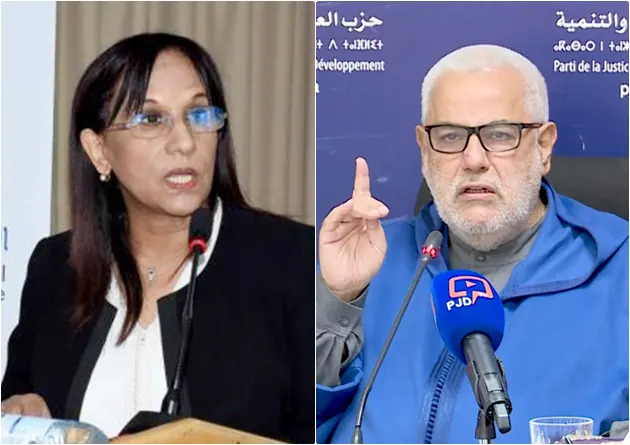
Moroccan ex-Prime Minister Abdelilah Benkirane has sparked controversy with his recent comments on women's rights and electoral integrity. Benkirane targeted Amine Bouchay, head of the National Human Rights Council, over her remarks on the use of mosques for electoral campaigning. He accused her of threatening the state's identity. This is not the first time Benkirane has clashed with Bouchay, whom he previously asked to apologize for discussing the feminization of poverty.
Benkirane's comments have been criticized by many as an attempt to silence Bouchay and undermine the National Human Rights Council's role in promoting human rights and democratic values. The Council has been monitoring electoral irregularities, including the use of mosques for campaigning, which is prohibited by Moroccan law. Bouchay's remarks were based on the Council's findings, which included 44 cases of electoral irregularities and six cases of campaigning in mosques.
Critics argue that Benkirane's stance is an attempt to defend his party's interests and undermine the opposition. His comments have been seen as an attack on women's rights and the independence of institutions. Benkirane has a history of making statements that have been criticized as sexist and misogynistic. In 2015, he compared women in parliament to chandeliers that had gone out.
The controversy highlights the challenges faced by women's rights activists in Morocco. Despite progress in recent years, women continue to face significant barriers in politics and public life. Benkirane's comments have been condemned by many as an attempt to roll back gains made by women's rights activists.
The National Human Rights Council's report on the elections highlighted several irregularities, including the use of mosques for campaigning and the distribution of cash and goods to voters. The Council's findings were based on a thorough investigation and were intended to promote transparency and accountability in the electoral process.
Benkirane's party, the Justice and Development Party, has a long history of using mosques as a platform for campaigning. Critics argue that this approach undermines the separation of church and state and can be used to manipulate voters. The use of mosques for campaigning is prohibited by Moroccan law, and critics argue that Benkirane's comments are an attempt to justify this practice.
The controversy has sparked a wider debate about the role of religion in politics and the importance of protecting women's rights. Many Moroccans have expressed support for Bouchay and the National Human Rights Council, and have called for greater transparency and accountability in the electoral process. The government's response to the controversy will be closely watched by human rights activists and observers.
Key points
- Critics argue that Benkirane's comments are an attempt to undermine the independence of institutions and defend his party's interests.
- The controversy highlights the challenges faced by women's rights activists in Morocco and the need for greater protection of women's rights.
- The use of mosques for campaigning is prohibited by Moroccan law, and critics argue that Benkirane's comments are an attempt to justify this practice.