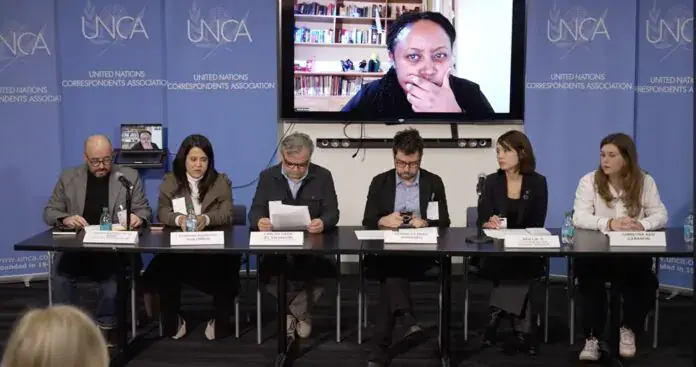
The Committee to Protect Journalists (CPJ) recently presented an alarming picture of press freedom in 2026 at a meeting with the United Nations Correspondents Association (UNCA). According to CPJ, 2025 was the deadliest year on record for journalists, with a significant increase in killings and imprisonments. The conference took place ahead of the 36th International Press Freedom Awards, scheduled for November 19 in New York.
CPJ reported that for the fifth consecutive year, over 300 reporters were incarcerated worldwide at year's end. The organization highlighted the stories of journalists who directly experienced repression, including Lebanese photojournalist Christina Assi, who was seriously injured in an Israeli attack while working on the Lebanese-Israeli border. Her Reuters colleague, Issam Abdallah, was killed in the attack.
Assi lost a leg in the attack and recalled wearing PRESS jackets and having cameras, yet was still targeted. She denounced the lack of justice three years after the attack, citing a UNESCO report that 86% of journalist murders worldwide remain unpunished. Investigative journalist Szabolcs Panyi from Hungary also testified about being spied on using Pegasus software and temporarily forced to leave the country.
Panyi's testimony highlighted the challenges faced by independent media outlets in Hungary, which were progressively weakened through takeovers by businessmen close to power, smear campaigns, and surveillance. Colombian journalist Stephanie Rodríguez, who fled to the United States after facing threats in her homeland, reported on ICE operations and the plight of immigrant communities.
Rodríguez was arrested by federal authorities and held for twenty days, ten of which were in solitary confinement. Carlos Dada, founder of the Salvadoran investigative newspaper El Faro, denounced the repression under President Nayib Bukele, stating that 22 of his 30 editorial staff members were targeted by the Pegasus system. Much of Salvadoran independent journalism has now been forced into exile.
The CPJ also highlighted the cases of journalists unable to participate due to imprisonment, including Burmese photojournalist Sai Zaw Thaike, who is serving a twenty-year forced labor sentence. In Eritrea, 16 journalists have been detained without trial since 2001, with their families having no reliable information about their conditions.
A question arose during the debate about how to more forcefully judge and denounce violations of press freedom committed by countries that call themselves democracies. CPJ's director of programs, Carlos Martínez de la Serna, responded that today no country can consider itself immune from serious attacks on journalism, and democracies have even greater responsibilities.
Key points
- 2025 was the deadliest year on record for journalists.
- Over 300 reporters were incarcerated worldwide at year's end for the fifth consecutive year.
- 86% of journalist murders worldwide remain unpunished.
Reporting sources
- Journalists killed, spied on, and imprisoned: CPJ denounces impunity at the UN · Ghana News Agency