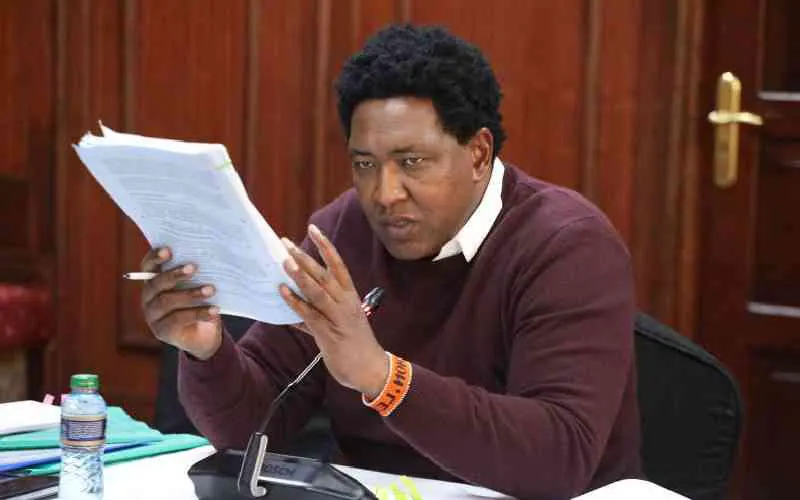
The County Oversight and Accountability Bill, sponsored by Narok Senator Ledama Olekina, aims to enhance public financial accountability by county governments and establish a framework for public participation and oversight of revenue allocated to counties. However, the Council of Governors (CoG) has opposed the bill, stating that it attempts to transform an institutional power reserved for the Senate as a collective House into personalized political authority. The CoG argues that the bill's provisions are already adequately provided for under the Constitution and existing statutory frameworks.
The CoG Director of Committees, Kizito Wangalwa, noted that the bill creates unnecessary duplication and risks undermining the constitutional allocation of functions, the separation of powers, and the established framework for county oversight and citizen-centered accountability. The Council appreciates the intent of the bill in institutionalizing public participation and deepening public financial accountability at the county level but opposes it in its entirety. The CoG urges the National Assembly not to proceed with the bill and to withdraw it from further consideration.
One of the reasons the CoG opposes the bill is that it duplicates existing laws, with Wangalwa stating that public participation is already extensively provided for in Part VIII of the County Governments Act. The bill, if passed, would create a parallel structure and risk duplicative and conflicting obligations on counties. The CoG also argues that the Senator-led oversight architecture is unconstitutional, citing a Supreme Court ruling that Senators cannot oversee county governments at the county level.
The Supreme Court ruling, cited by the CoG, states that legislative overreach that fails to respect the functional and institutional integrity of county governments offends Article 189(1) of the Constitution. The CoG argues that the bill's clauses creating a Senator-led oversight and public participation program are therefore unconstitutional. The Council has also told the committee that the bill mischaracterizes the equitable share of revenue as money allocated by the National Government.
The CoG notes that counties receive an equitable share of revenue raised nationally, which is a constitutional entitlement under Articles 202 and 203 of the Constitution. The bill's framing is therefore constitutionally incorrect, according to Wangalwa. Another issue the CoG has pointed out is that the bill creates an unfunded mandate, establishing a framework for the construction, renovation, and maintenance of public participation facilities in wards without identifying a funding mechanism.
The CoG argues that counties require additional, dedicated funding to finance these facilities and programs if they become necessary. The bill is misaligned with the counties' planning and resource allocation framework, guided by long-term, medium-term, and short-term plans, including the County Integrated Development Plans. The CoG's position is supported by reports of the Controller of Budget.
The County Oversight and Accountability Bill was passed by the Senate on July 21 and transmitted to the National Assembly. The bill aims to promote accountability and transparency in the acquisition and disposal of assets and the incurring of liabilities by county governments. The CoG's opposition to the bill may impact its chances of becoming law, with the National Assembly Committee on Regional Integration considering the Council's submissions.
Key points
- The Council of Governors opposes the County Oversight and Accountability Bill, citing concerns that it violates the Constitution and risks crippling county operations.
- The bill's provisions are already adequately provided for under the Constitution and existing statutory frameworks, according to the CoG.
- The CoG argues that the bill creates an unfunded mandate and mischaracterizes the equitable share of revenue as money allocated by the National Government.