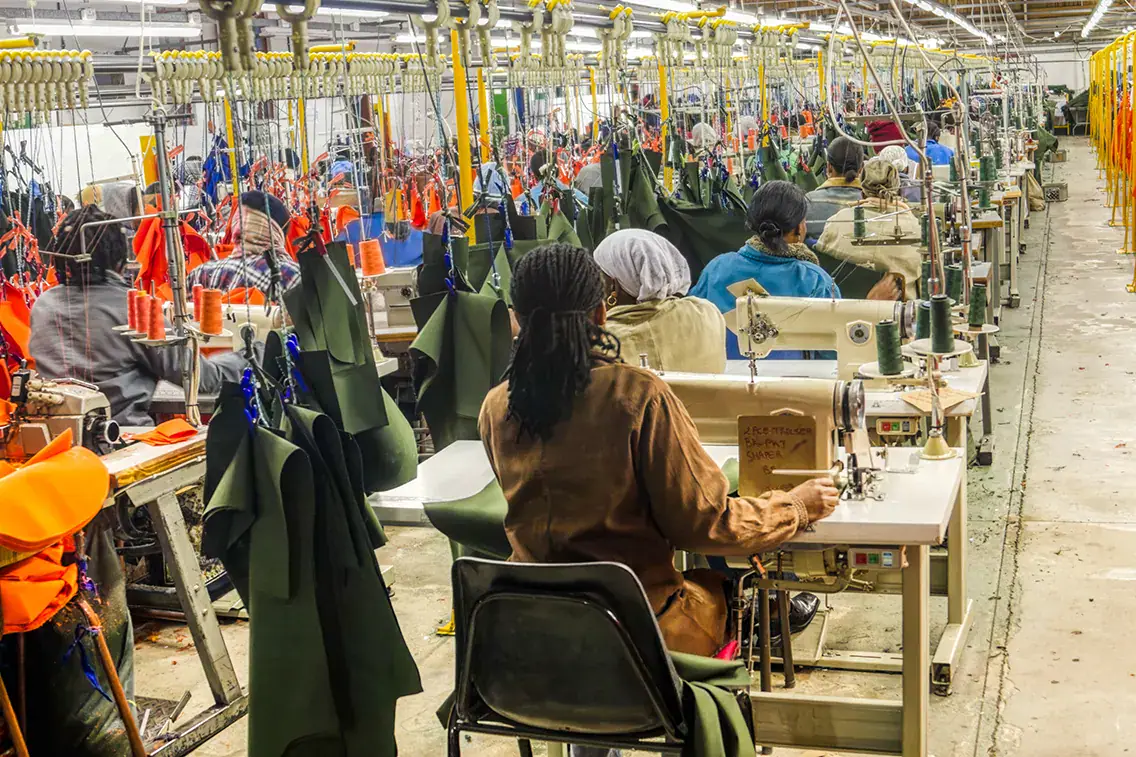
The African continent's push to add value to its cotton production could be the catalyst for an industrial revolution. However, this requires more coordination among countries and industry players. According to Teboho Kobeli, founder and Managing Director of Afri-Expo Textiles, African textile markets need to move beyond basic processing to full end-to-end operations. This involves sourcing and processing raw cotton, manufacturing, and supplying finished textiles and apparel. Kobeli's company, based in Maseru, Lesotho, has been operating for 15 years.
Lesotho's textile industry is a significant beneficiary of the African Growth and Opportunity Act (AGOA), with exports reaching $237.3 million in 2024. The industry is one of the country's main sectors, employing a large portion of the population. However, the sector faces challenges, including fragmentation and lack of coordination among African countries and cotton producers. Kobeli notes that African countries operate in "fragmented silos" without centralized coordination, hindering the growth of the industry.
Kobeli's experience in the textile industry began in China in the mid-2000s. He was inspired by China's model of setting up multiple factories and structuring ecosystems for production and export. He aimed to replicate this model in Lesotho, but faced challenges due to the fragmentation of the African textile industry. As a result, his company imports raw textiles from China and other Asian countries, despite a significant proportion of the cotton being grown in African countries.
The COVID-19 pandemic and US tariffs on Lesotho's exports had a significant impact on the country's textile industry. The pandemic led to job cuts, and the industry only began recovering in 2021. The US tariffs, imposed by President Donald Trump, resulted in a 50% rate, one of the highest in the world at the time. The rate was later lowered to 15%, but it was still high enough to force the country's central bank to cut its growth projections for 2025 and 2026.
Kobeli believes that African governments have been focusing on attracting foreign investors, but neglecting homegrown entrepreneurs. He argues that incentives should be offered to local businesses to support their growth and development. Kobeli's company has had to navigate challenges, including limited access to trade finance and structured incentives to support equipment and raw material acquisition.
Lesotho is exploring new markets for its textile exports, including neighbouring South Africa and other countries on the continent. Kobeli believes that building full end-to-end operations in Africa would kickstart the industrial age. He also thinks that the textile industry can create mass employment and become a central economic pillar. With this, he hopes that political stability across the continent may also be achievable.
The production of apparel is a basic need, and Kobeli believes that it will always be relevant. He is optimistic about the potential of the textile industry in Africa, but notes that it requires coordination and support from governments and industry players. With the right approach, Kobeli thinks that Africa can take care of its own people and build a sustainable textile industry.
Key points
- African textile markets need to move beyond basic processing to full end-to-end operations.
- The textile industry can create mass employment and become a central economic pillar.
- Coordination among countries and industry players is necessary to trigger an industrial revolution.